
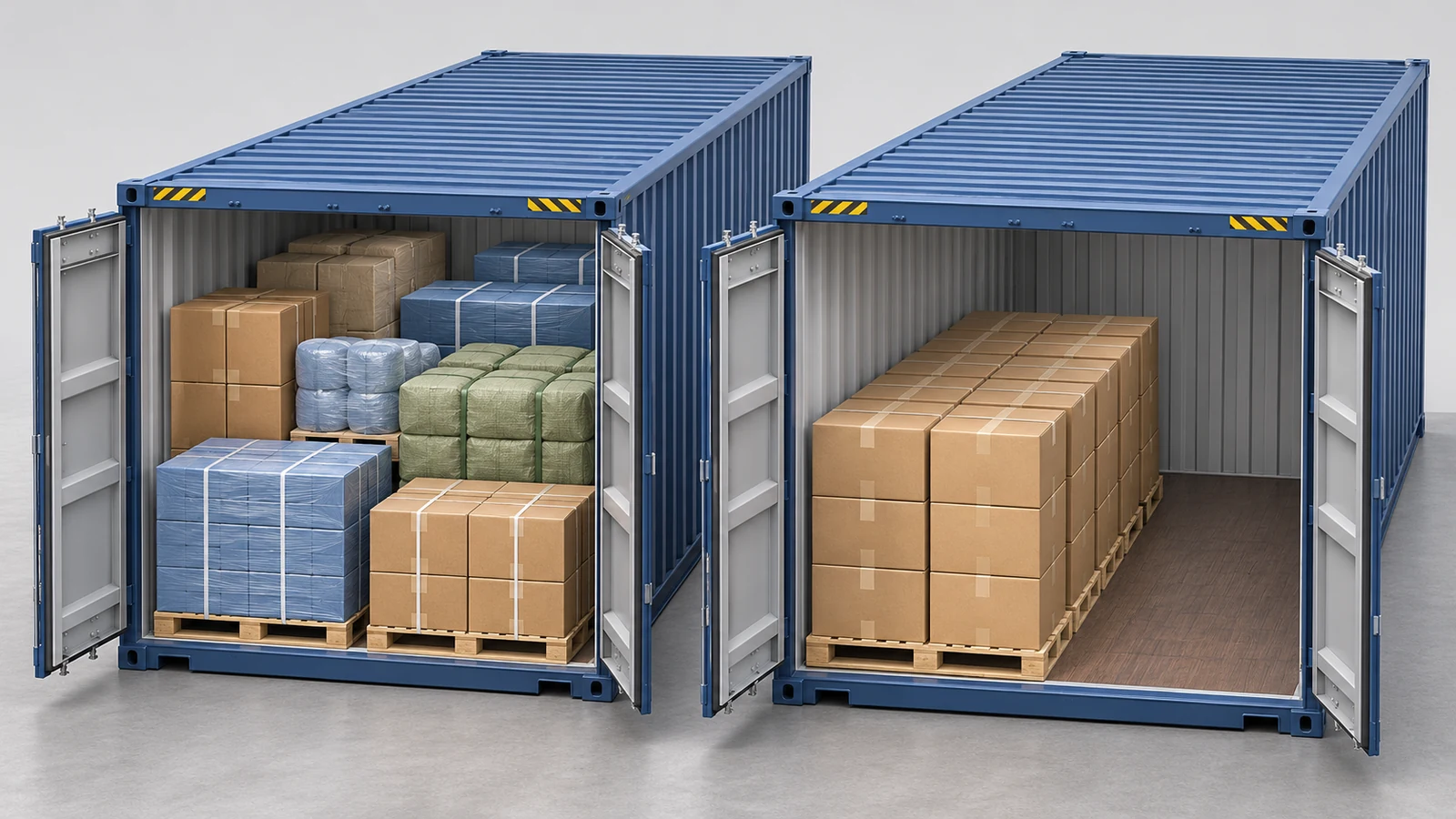
Buyer's consolidation and LCL answer different questions. Buyer's consolidation describes how a buyer brings supplier orders together. LCL, or less than container load, describes a transport service in which cargo shares container space. A buyer can consolidate several supplier orders and then book LCL, or use a full container if that fits the shipment.
Our guide to shipping from multiple suppliers in China covers the coordination process. This comparison separates that process from the capacity booking. Once you separate the two, you can ask for useful quotes on the same cargo.
Key takeaways
- Supplier grouping and container booking are separate decisions.
- Compare three scenarios: separate departures, buyer-consolidated LCL and buyer-consolidated FCL.
- Use final cargo, complete charges and a realistic delivery window.
- Decide who coordinates receiving and release even when a forwarder books the transport.
What is the difference between buyer's consolidation and LCL?
Think of buyer's consolidation as an order-management arrangement and LCL as a capacity service. The first determines how your supplier batches meet and become ready for onward shipment. The second determines how the approved cargo travels within the booked ocean service. You may need both for the same order.
| Question | Buyer's consolidation | LCL service |
|---|---|---|
| What is being organized? | Several supplier batches for the buyer's plan | Cargo sharing container capacity |
| What must the buyer decide? | Ready dates, receiving, product holds and release | Acceptable service, charges and delivery timing |
| What records matter? | POs, receipts, inspection status and final cargo list | Cargo measurements, booking and transport documents |
| Does it require a full container? | No automatic requirement | It is the shared-container option |
| Can the two work together? | Yes, approved grouped orders can use LCL | Yes, subject to provider and cargo acceptance |

Maersk's explanation of FCL and LCL distinguishes shared space from booking an entire container. Neither booking choice settles whether your suppliers will finish on the same date. That coordination still needs an owner.
Avoid asking only, "Is consolidation cheaper than LCL?" Specify the arrangement. Do you mean sending separate LCL shipments from each supplier, receiving all suppliers at one warehouse before LCL, or receiving them before FCL? Ask providers to price those arrangements separately.
When does buyer-consolidated LCL fit an order?
Consider buyer-consolidated LCL when several approved batches can meet one departure window but the combined load doesn't justify the available full-container option. Ask for a complete quote. The right choice depends on cargo density, handling requirements, local charges and the service offered for your actual destination.
Consolidating before LCL can give the buyer one coordination point for receiving and release. It may also add warehouse work and an extra movement. Ask where the cargo will physically go after receiving and whether the quoted service includes that transfer. More coordination doesn't automatically mean fewer handling steps.
Confirm acceptance for every product. Mixed goods can introduce different packing and handling requirements. Share descriptions, dimensions and any restrictions before collection. A quotation based on "general cargo" needs revisiting if the final order contains items the provider hasn't accepted.
For a provider-specific example, Maersk's LCL terms explain its weight/measurement charging basis and additional-service terms. Use the terms of your actual quote when you calculate the bill. Don't assume another provider uses identical minimums, rounding or included services.
When might a full container be more practical?
Request a full-container alternative when your cargo, handling needs and timing make it feasible. Evaluate the complete option rather than relying on a universal CBM cutoff. Check the load plan, weight limits, equipment and final delivery arrangements with the provider. Nominal container volume alone doesn't establish what your goods can safely fit.
FCL can offer a different operating arrangement from shared-container cargo. It also requires decisions about packing the container, collecting it and handling it at destination. Ask who performs each task and what happens if the premises cannot receive the chosen equipment.
If an applicable packed-container shipment needs VGM, arrange that responsibility before the relevant deadline. IMO's VGM guidance identifies the shipper's responsibility and the verified-mass requirement. A full-container quote should make the operational handover clear rather than leaving you to discover it near departure.
Don't select FCL just to use a "single container" marketing phrase. A partly filled container may suit the cargo. Price the unused capacity as part of the decision. Compare it with the actual LCL service available for the same approved goods.
How should you compare three shipment scenarios?
Price separate supplier departures, buyer-consolidated LCL and buyer-consolidated FCL using the same product quantities and delivery endpoint. Include collection, storage and handling. Record the earliest feasible departure and the decision deadline for each option. You can then see both the cost and the amount of coordination each plan requires.
| Scenario | What to price | What to check |
|---|---|---|
| Separate departures | Each supplier's complete movement | Repeated minimum charges, delivery timing and receiving burden |
| Buyer-consolidated LCL | Collection, warehouse work and the combined LCL service | Transfers, shared-service timing and applicable charges |
| Buyer-consolidated FCL | Collection, packing and full-container transport/delivery | Loading feasibility, weight and equipment handling |
Use our consolidation cost worksheet to record the actual charges. That avoids comparing a supplier's door-delivery estimate with a warehouse-to-port quote. If an expense is unknown, identify the gap and request it. A blank cell shouldn't become an assumed saving.
Our air versus sea freight guide covers another option when only part of the order is urgent. You don't have to wait until every supplier is ready to explore an approved split, although the changed documents and charges need confirmation.
What does a mixed-order example look like?
Consider a hypothetical importer buying tableware, stationery and seasonal decorations from different suppliers. The buyer needs them at one warehouse abroad, but the products have different ready dates. First decide which batches can wait together. Then obtain the capacity quotes for the cargo that will actually share the departure.
Suppose the seasonal decorations have a firm selling window while the stationery is routine replenishment. If the stationery supplier slips, waiting for it may be the wrong choice even if a larger combined load gives a lower transport rate per unit. The buying decision depends on the delivery requirement, not on container utilization alone.
Keep the supplier tracker updated and ask for a revised quote on the approved grouping. Don't leave a delayed batch on the final packing list if it will travel separately. The warehouse needs a release instruction identifying exactly what to dispatch.
Our existing Yiwu sourcing service covers the earlier purchasing stage. When the order spans factories or markets, keep each purchase record traceable even if the logistics team combines the goods for transport.
What should your forwarder or sourcing agent confirm?
Ask the team to identify the receiving point, the scope of warehouse work and the transport option being quoted. Specify who can authorize extra charges and release cargo. Request the documentation plan for the actual seller and exporter arrangement; grouped cargo doesn't by itself determine the invoice structure.
Ask whether the quote includes final delivery and what the receiving location must provide. Check the validity and the inputs that can change the price. Revisit the comparison when cargo dimensions or ready dates change rather than continuing with an obsolete estimate.
For China sourcing services, send the supplier list, product quantities and required delivery dates. Union Trust's sourcing minimum is $10,000 per order. Ask the team to confirm the applicable warehouse and shipping arrangements instead of treating that threshold as a standalone forwarding price.
Frequently asked questions
Does buyer's consolidation mean combining different buyers' orders?
Here it means coordinating several supplier batches for one buyer's shipment plan. Providers may use the term differently, so describe the actual arrangement. LCL may involve sharing container space with other shippers. Confirm cargo ownership, operational scope and the transport documents rather than relying on the label alone.
Is there one volume where FCL always becomes cheaper?
No universal volume determines the answer. Density, routing, minimum charges, handling and destination costs can change the comparison. Obtain complete LCL and FCL quotes for the same cargo. Also confirm whether the proposed load can be packed and delivered as planned.
Can a sourcing agent coordinate orders while a forwarder books LCL?
Yes, if their responsibilities and handover are agreed. The agent can coordinate supplier information and receiving while the forwarder handles the contracted transport service. Name the release authority and the person responsible for correcting cargo information so tasks don't fall between the two teams.