
If you’re interested in China’s foreign trade, you can’t ignore Guangdong. This southern Chinese province has been the country’s top export region for years. It’s not just a manufacturing hub—it’s a global powerhouse that drives a large part of China’s export growth.
In this first article of our China Foreign Trade Industry Chain series, we’ll break down Guangdong’s foreign trade industry chain. We’ll look at its overall layout, key city industrial belts, core advantages, development trends, and what it means for global businesses.
Whether you’re a buyer, investor, or just curious about how China’s exports work, this guide will give you a clear, easy-to-understand overview of Guangdong’s role in the global supply chain. Let’s dive in.
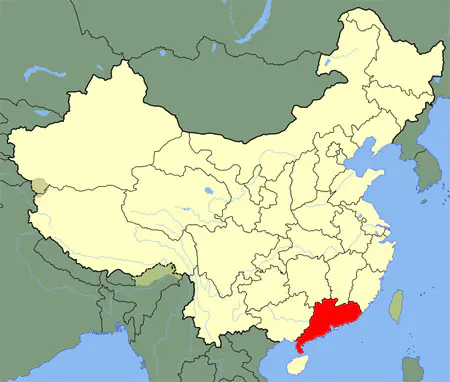
1. Guangdong’s Unbeatable Position in China’s Foreign Trade
Guangdong is more than just a province in southern China. It’s the engine of China’s export economy, holding the top spot in total export volume for many consecutive years. Its manufacturing output has long been among the highest in the country, accounting for nearly 15% of China’s total manufacturing output. In 2024 alone, Guangdong’s total foreign trade volume exceeded 8 trillion yuan, accounting for about one-fifth of China’s total foreign trade volume.
What makes Guangdong stand out? It benefits from a complete industrial system. China is the only country in the world with all 41 industrial categories, 207 industrial subcategories, and 666 industrial subclasses—and Guangdong is a key part of this system.
This complete industrial layout gives Guangdong strong self-sufficiency and risk resistance. It can meet diverse domestic needs and provide powerful support for exports. From raw materials to finished products, the supply chain here is seamless.
Guangdong is also home to a large number of high-tech enterprises, leading the country in innovation and technological upgrading. Its foreign trade is not just about quantity—it’s about quality and competitiveness.
In this article, we’ll explore why Guangdong is a leader in China’s foreign trade. We’ll break down its industrial belts, key industries, and what makes it a top choice for global trade partners.
2. Overall Layout of Guangdong’s Foreign Trade Industry Belt
Guangdong’s foreign trade industry belt is centered on the 9 core cities of the Guangdong-Hong Kong-Macao Greater Bay Area. These cities are divided into three major clusters: Guangzhou-Foshan-Zhaoqing, Shenzhen-Dongguan-Huizhou, and Zhuhai-Zhongshan-Jiangmen.
Each cluster has its own strengths, but they work together to form a unified and efficient industrial chain. This regional cooperation ensures that resources are shared, costs are reduced, and production efficiency is maximized.
The industrial belt has three key characteristics: industrial clustering, local supply chains, and global export orientation. Enterprises gather in specific areas, forming industrial clusters that focus on different products.
For example, electronics companies cluster in Shenzhen, textile and apparel enterprises in Guangzhou and Dongguan, and home appliances in Foshan. This clustering makes it easy for enterprises to cooperate and support each other.
Local supply chains are another big advantage. Most raw materials and parts needed for production are available locally. This reduces transportation costs and delivery time, making Guangdong’s exports more competitive.
Finally, the entire industrial belt is focused on global markets. Products from Guangdong are sold to more than 200 countries and regions around the world, covering everything from consumer goods to high-tech products.
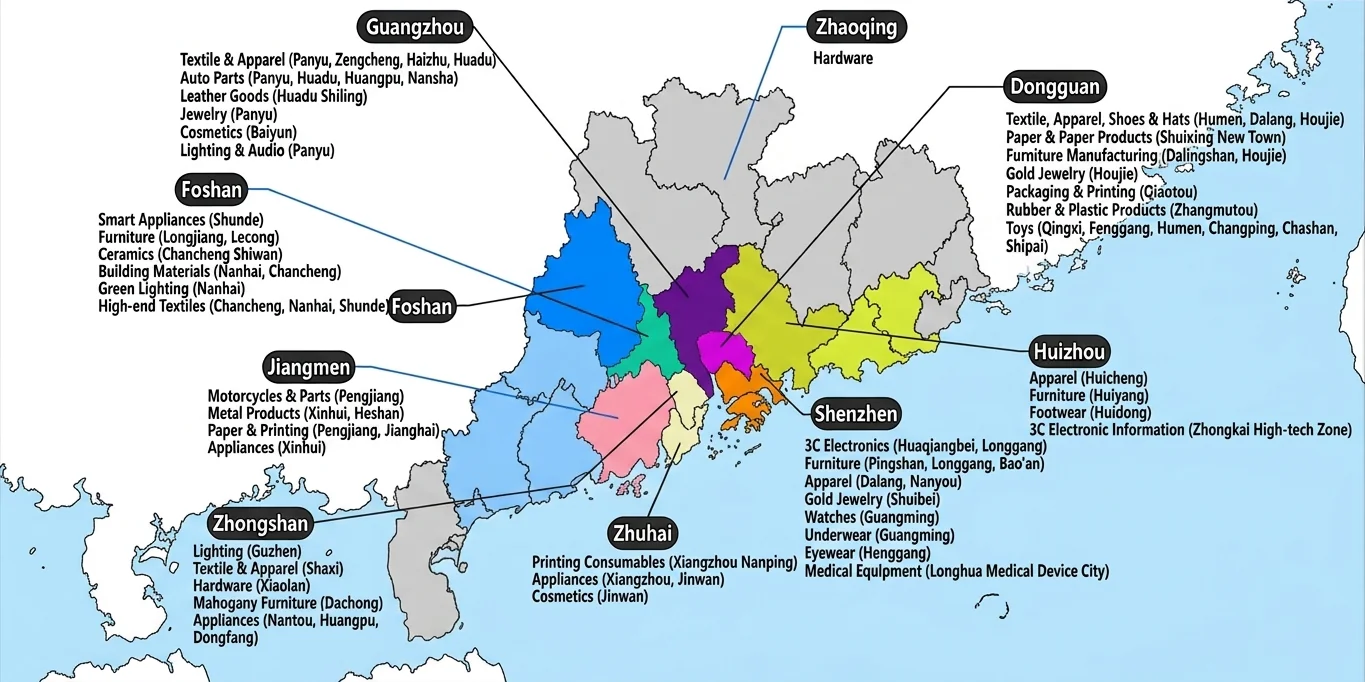
3. Key City Industry Profiles: The Backbone of Guangdong’s Exports
Guangdong’s foreign trade strength comes from its key cities. Each city has its own characteristic industries, forming a complementary industrial ecosystem. Let’s take a closer look at the most important ones.
Shenzhen: The High-Tech Export Hub
Shenzhen is the heart of Guangdong’s high-tech exports. It’s home to Huaqiangbei, one of the world’s largest electronics distribution centers. Here, you can find all kinds of 3C electronics and accessories, with more than 10,000 merchants gathering in the area, covering every link from component supply to finished product sales. The market updates products at an astonishing speed—new mobile phone accessories can appear on the shelves within 24 hours of a new phone’s release.
Huaqiangbei gathers a huge number of 3C electronic products, including mobile phones, computers, tablets, and smart wearables. The products are diverse and updated quickly, meeting global market demand. From low-cost basic models to high-end smart devices, Huaqiangbei can meet the needs of different customer groups, from individual consumers to large-scale distributors. It also serves as a testing ground for new electronic products, where many innovative gadgets first appear before being promoted to the global market.
Shenzhen is also famous for its gold jewelry industry, centered in Shuibei. This one-square-kilometer area has an annual transaction volume of over 100 billion yuan, accounting for more than 50% of China’s gold jewelry wholesale market.
Another key industry in Shenzhen is eyewear, concentrated in Henggang. Nearly 1,200 eyewear manufacturers are located within a 50-kilometer area, producing over 125 million pairs of glasses every year.
These glasses account for 80% of Shenzhen’s exports and more than half of the world’s mid-to-high-end eyewear manufacturing. Many international brands, such as LV, Gucci, and Ray-Ban, have their frames produced here.
Shenzhen also has a strong medical device industry. It has more than 1,800 medical device manufacturers, including 3 of the world’s top 100 medical device companies. Its medical device output accounts for about 10% of China’s total.
Guangzhou: The Hub of Textiles, Leather, and Cosmetics
Guangzhou is a traditional manufacturing and trade center. Its textile and apparel industry is one of the largest in the world, with more than 613,200 market entities involved in the industry, accounting for more than 20% of the total market entities in Guangzhou. These entities include not only large-scale garment factories but also small and medium-sized processing workshops, fabric suppliers, and design studios, forming a dense industrial network.
The textile and apparel industry is concentrated in Panyu, Zengcheng, Haizhu, and Huadu districts. Guangzhou has nearly 150 professional textile and apparel wholesale markets, making it the largest clothing distribution base in China and even the world. Famous markets such as Baima Clothing Market and Shahe Clothing Market attract buyers from all over the world every year, with daily transaction volumes reaching hundreds of millions of yuan. These markets not only sell finished clothing but also provide one-stop services from fabric selection to sample customization.
Huadu District’s Shiling Town is known as the “Capital of Chinese Leather Goods.” It has more than 8,800 leather goods enterprises, forming a 10-billion-yuan characteristic industrial cluster.
There are also more than 16,800 supporting service providers in Shiling Town, further enhancing the comprehensive strength of the leather goods industry. Products here are exported to all over the world.
Guangzhou’s Baiyun District is a major cosmetics production base. Its cosmetics industrial output exceeds 100 billion yuan, accounting for 55% of China’s total. It has 1,870 certified cosmetics manufacturers.
By 2025, Guangzhou’s cosmetics output is expected to reach about 150 billion yuan. The city is also a key hub for audio-visual equipment, with Panyu District accounting for 40% of China’s performance equipment manufacturers.
Dongguan: The World’s Toy and Apparel Manufacturing Base
Dongguan is known as the “World Factory,” and its toy and apparel industries are the backbone of its exports. Humen Town, in particular, is famous for its clothing industry.
Humen has more than 2,300 clothing production enterprises, selling 2 billion pieces of clothing every year. In the past five years, the number of e-commerce entities here has exceeded 10,000, with online sales reaching 51.8 billion yuan.
Dongguan is also a major toy production base, with more than 4,000 toy manufacturers and nearly 1,500 upstream and downstream supporting enterprises. Its toy industry scale ranks first in the Pearl River Delta, with annual output exceeding 10 billion yuan. The toys produced here cover a wide range, from traditional plush toys and plastic toys to high-tech intelligent toys and collectible trend toys, which are exported to more than 100 countries and regions.
Thanks to mature OEM production technology, many Dongguan enterprises have transformed into independent IP operations. They have created original IPs such as Laura, Angelboy, Cassy, and Fuzoo, which have gained popularity among young consumers at home and abroad. These original IPs not only drive toy sales but also extend to derivatives such as stationery, clothing, and peripheral products, forming a complete IP industrial chain.
Dongguan’s furniture industry is also well-known. Dalingshan and Houjie towns are major furniture production bases, with the “Dongguan Furniture” brand enjoying a good reputation at home and abroad.
The city’s paper industry is also growing rapidly. The local government aims to achieve a paper industry output value of 115 billion yuan by 2027, with leading enterprises such as Nine Dragons Paper and Lee & Man Paper.
Foshan: The Home Appliance and Ceramics Capital
Foshan is a major manufacturing city, with its home appliance and ceramics industries leading the country. Shunde District, in particular, has been named the “Capital of Chinese Home Appliances” for five consecutive years.
Shunde is home to well-known home appliance enterprises such as Midea, Galanz, and Hisense, as well as emerging brands like Bear Electric and Delma. Its home appliance industry is complete and highly competitive.
Lecong Town in Shunde has more than 30,000 furniture industry-related enterprises. It covers the entire process from raw material procurement and design to production and logistics.
The town has nearly 26,000 independent brands, making it a major furniture production and export base. Foshan’s ceramics industry is also world-famous, with Shiwan Town as its core.
Foshan is the world’s largest ceramic trading center, supporting center, and export center. Its ceramic output exceeds 2 billion square meters every year, accounting for more than 30% of China’s total.
Nanhai District is a major lighting production base, with an annual output value of over 20 billion yuan in the optoelectronic display and lighting industry. Its lighting products are exported to all over the world.
Zhongshan: Lighting, Home Appliances, and Hardware Hub
Zhongshan is famous for its lighting industry, with Guzhen Town known as the “Capital of Chinese Lighting.” The town has more than 76,000 business entities, with lighting and supporting enterprises accounting for over 80%.
Guzhen’s lighting sales account for more than 70% of China’s lighting market, with an annual sales volume exceeding 100 billion yuan. It’s a major global lighting production and export base.
Nantou and Huangpu towns in Zhongshan are major home appliance production bases. The city has the most complete home appliance industrial chain in the Guangdong-Hong Kong-Macao Greater Bay Area.
There are more than 10,000 home appliance and supporting enterprises in Zhongshan, with main business income exceeding 200 billion yuan, accounting for 13.5% of the national home appliance industry.
Xiaolan Town is a major hardware production base, known as the “Base of Chinese Hardware Products” and the “Export Base of Chinese Hardware Products (Xiaolan Locks).” It has more than 3,000 hardware enterprises.
Dachong Town is a core area for redwood furniture, with more than 800 furniture production and sales enterprises and nearly 80,000 employees. It has cultivated many leading redwood furniture brands.
Zhuhai, Huizhou, and Jiangmen: Supporting Export Industries
While Shenzhen, Guangzhou, Dongguan, Foshan, and Zhongshan are the main forces, Zhuhai, Huizhou, and Jiangmen also play important roles in Guangdong’s foreign trade industry chain.
Zhuhai’s Nanning District is a major printing consumables production base, with its products exported to global markets. The city also has a strong home appliance and cosmetics industry in Xiangzhou and Jinwan districts.
Huizhou’s Zhongkai High-tech Zone is a key 3C electronic information base. It also has clothing, furniture, and footwear industries in Huicheng, Huiyang, and Huidong counties.
Jiangmen’s Pengjiang District is a major motorcycle and parts production base. Xinhui District is famous for its tangerine peel and metal products, with a complete paper and printing industry.
These cities provide important supporting services for the core industrial belts. They supply raw materials, parts, and logistics support, ensuring the smooth operation of the entire industrial chain.
4. Core Competitive Advantages of Guangdong’s Export Industry
Guangdong’s leading position in China’s foreign trade is not accidental. It has four core competitive advantages that make it stand out in the global market. Let’s explore each one in detail.

Complete Industrial Chain
One of Guangdong’s biggest advantages is its complete industrial chain. From raw material supply and parts production to finished product assembly and export, every link is well-developed. This means that enterprises do not need to rely on external suppliers for key components, which greatly shortens the production cycle and reduces the risk of supply chain disruptions.
For example, in the electronic information industry, enterprises cooperate closely in raw material supply, parts production, and whole-machine assembly. A mobile phone produced in Shenzhen can source its chip from local semiconductor enterprises, its screen from nearby display manufacturers, and its casing from local plastic processing factories. This improves production efficiency, product quality, and reduces costs, making Shenzhen’s electronic products more competitive in the global market.
In the textile and apparel industry, you can find everything from cotton spinning and weaving to dyeing and clothing production. This one-stop industrial chain makes it easy for enterprises to respond to market changes quickly.
The complete industrial chain also reduces dependence on external suppliers. Enterprises can find most of the resources they need locally, which improves stability and reduces risks.
High Enterprise Concentration
Enterprise clustering is a key feature of Guangdong’s industrial belt. Enterprises gather in specific areas, bringing advantages such as resource sharing, technical exchange, and talent gathering.
For example, Huaqiangbei’s electronics enterprises, Shuibei’s gold jewelry enterprises, and Guzhen’s lighting enterprises all gather in small areas. This makes it easy for enterprises to cooperate and learn from each other.
Clustering also reduces costs. Enterprises can share logistics, warehousing, and other services, lowering their operating costs. It also attracts more talents, as workers can easily find jobs in the same industry.
The high concentration of enterprises also promotes competition and innovation. Enterprises strive to improve their products and services to stand out in the cluster.
Mature Cross-Border E-Commerce and Logistics
Guangdong has a mature cross-border e-commerce and logistics system, which is crucial for its export growth. It has many cross-border e-commerce pilot cities, such as Shenzhen, Guangzhou, and Dongguan.
These cities have perfect cross-border e-commerce platforms, logistics channels, and customs clearance services. This makes it easy for enterprises to sell their products to global markets directly.
Guangdong’s logistics network is also well-developed. It has major ports such as Shenzhen Port and Guangzhou Port, which are among the busiest ports in the world. This ensures fast and efficient delivery of goods.
The mature cross-border e-commerce and logistics system reduces the threshold for enterprises to go global. Even small and medium-sized enterprises can easily export their products to other countries.
Strong Innovation Capability
Guangdong has a strong innovation capability, which drives the upgrading of its export industry. It has a large number of high-tech enterprises and R&D institutions, focusing on technological innovation.
For example, Shenzhen’s electronic information industry is constantly innovating, launching new products such as smart wearables and 5G devices. Foshan’s home appliance enterprises are developing smart home products to meet global demand.
The local government also supports innovation by providing policies and funding. This encourages enterprises to invest in R&D and improve their core competitiveness.
Strong innovation capability allows Guangdong’s export products to stay ahead of the market. It also helps enterprises move up the value chain, from OEM production to independent brand operation.
5. Development Trends of Guangdong’s Foreign Trade Industry Chain
Guangdong’s foreign trade industry chain is not standing still. It’s constantly evolving to adapt to global market changes and technological development. Here are the key trends to watch.

Digital Transformation
Digital transformation is a major trend in Guangdong’s foreign trade industry. More and more enterprises are using digital technologies to improve their operations and expand their global reach. Many traditional manufacturing enterprises have introduced intelligent production lines, using robots and automated equipment to replace manual labor, which not only improves production efficiency but also reduces product defect rates.
Cross-border e-commerce platforms are becoming more important. Enterprises are using platforms like Alibaba International Station and Amazon to sell their products directly to overseas customers, bypassing intermediate links and increasing profit margins. Many small and medium-sized enterprises have also established their own independent websites and social media accounts to promote their products and interact with customers directly.
Digital technologies such as big data and artificial intelligence are also being used to analyze market demand, optimize production, and improve customer service. This helps enterprises make better decisions and reduce costs.
The local government is also promoting digital transformation by building digital industrial parks and providing training for enterprises. This will further enhance the competitiveness of Guangdong’s foreign trade.
Focus on High-End Products
Guangdong is shifting from low-end manufacturing to high-end products. Enterprises are investing more in R&D to develop high-value-added products, such as smart home appliances, high-tech electronics, and medical devices.
This shift is driven by global market demand. Consumers around the world are increasingly looking for high-quality, high-tech products. Guangdong’s enterprises are responding to this demand by upgrading their products.
Many enterprises are also building independent brands. Instead of just doing OEM production, they are creating their own brands and selling them globally. This helps them increase their profit margins and build long-term competitiveness.
The local government is supporting this shift by providing policies and funding for high-end manufacturing. This will help Guangdong’s foreign trade industry move up the global value chain.
Green and Sustainable Development
Green and sustainable development is another important trend. With increasing global attention to environmental protection, Guangdong’s enterprises are focusing on green production. The local government has formulated strict environmental protection standards, and enterprises that fail to meet the standards are not allowed to produce, which promotes the upgrading of the entire industry.
Many enterprises are adopting environmentally friendly production technologies and materials. For example, ceramic enterprises in Foshan have introduced clean production technologies to reduce sewage and waste gas emissions; textile enterprises in Guangzhou are using environmentally friendly dyes and fabrics to produce green and healthy clothing. They are also reducing energy consumption and carbon emissions to meet global environmental standards, such as the EU’s carbon border adjustment mechanism (CBAM).
The local government is promoting green development by formulating environmental policies and supporting green enterprises. This will help Guangdong’s exports meet the environmental requirements of global markets.
Green and sustainable development is not just a trend—it’s a necessity. Enterprises that adopt green production will have a competitive advantage in the global market.
Deepening Cooperation in the Guangdong-Hong Kong-Macao Greater Bay Area
Cooperation in the Guangdong-Hong Kong-Macao Greater Bay Area is deepening. The three regions are working together to build a world-class industrial cluster.
Hong Kong provides financial, legal, and professional services, while Macao focuses on tourism and cultural exchanges. Guangdong provides manufacturing and production capacity.
This cooperation helps enterprises in Guangdong expand their global reach. They can use Hong Kong’s international financial center and Macao’s tourism resources to promote their products.
The Greater Bay Area’s infrastructure is also being improved, with better transportation and communication links. This will further enhance the efficiency of the industrial chain and promote economic growth.
Conclusion & Next Series Preview
Guangdong’s foreign trade industry chain is a powerful engine of China’s export economy. Its complete industrial chain, high enterprise concentration, mature logistics, and strong innovation capability make it a global manufacturing powerhouse. Every year, millions of high-quality products from Guangdong are shipped to all over the world, affecting the lives of people in more than 200 countries and regions.
From Shenzhen’s high-tech electronics to Foshan’s home appliances, from Guangzhou’s textiles to Zhongshan’s lighting, each city contributes to Guangdong’s export success. Together, they form a dynamic and competitive industrial ecosystem.
For global businesses, Guangdong is more than just a supplier. It’s a reliable partner that can provide high-quality products, efficient services, and stable supply chains. Whether you’re looking to source products, find OEM partners, or invest in the manufacturing industry, Guangdong has a lot to offer. Its open business environment, complete industrial supporting facilities, and professional talent team make it an ideal choice for global cooperation.
As the first article in our China Foreign Trade Industry Chain series, we’ve covered the basics of Guangdong’s foreign trade industry. In the next article, we’ll turn our attention to Zhejiang Province.
Zhejiang is another major player in China’s foreign trade, with strong industries such as textiles, small commodities, and cross-border e-commerce. We’ll explore its industrial belt, core advantages, and what makes it unique.
Stay tuned for our next article to learn more about China’s foreign trade industry chain. If you have any questions about Guangdong’s foreign trade, feel free to send we an email!