
Have you ever wondered where the sports shoes, home decor, and new energy parts in your local store come from? Chances are, many of them trace back to Fujian, a coastal province in eastern China that powers a huge part of China’s Foreign Trade Industry Chain.
This province is not just a manufacturing hub. It is the core node of the Maritime Silk Road, with a unique geographical advantage facing Taiwan and Southeast Asia. It has the largest coastal economic zone in China, with world-class port infrastructure that makes cross-border trade easier than ever. It combines traditional consumer goods clusters with cutting-edge new energy industries, creating a one-stop sourcing spot for global buyers.
In this guide, we will break down Fujian’s key Foreign Trade Industry Belts. We will look at what makes each region unique, what products they specialize in, and why they are so important for global supply chains. Whether you are a small business owner sourcing goods or a supply chain manager, this guide will help you understand how Fujian works.
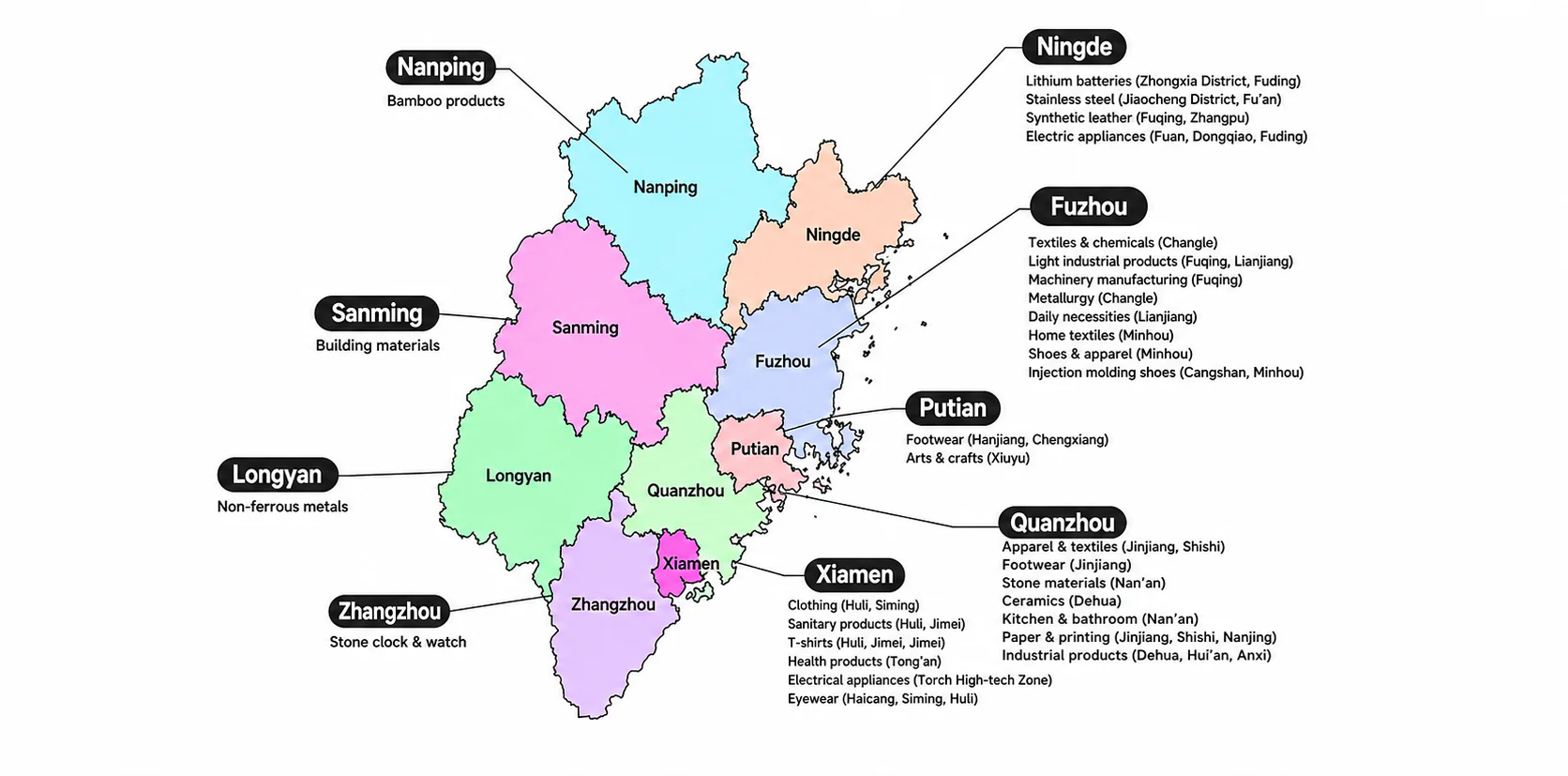
Chapter 1: Overview of Fujian’s Foreign Trade & Industrial Cluster Advantages
Fujian has long been the gateway of China’s trade with Southeast Asia and the world. What makes it stand out is not just its port advantage, but how it balances traditional consumer goods manufacturing with cutting-edge new energy industries.
Unlike other regions that focus only on one type of industry, Fujian has built clusters that cover everything from global lithium battery production to everyday consumer goods. Each city, and even each town, focuses on perfecting one specific industry. This creates a complete, efficient supply chain right in one area.
For example, if you want to source sports shoes, you can find every single part you need within Jinjiang city. The fabric factory, the sole maker, the design studio, and the assembly plant are all right there. This cuts down on costs and delivery times dramatically.
Fujian’s economy is driven by a mix of strong independent brands and flexible private businesses. This mix allows it to handle both massive new energy industrial orders and small custom consumer orders. It also has a very developed cross-border trade infrastructure, thanks to its geographical location.
To give you a quick overview, here are the core industrial belts we will cover in this guide:
| Industrial Belt | Core Products | Key Global/National Market Share |
| Quanzhou | Footwear, textiles, stone, ceramics | 40% of China’s sports shoes output; 60% of China’s craft ceramics exports |
| Xiamen | Sanitary ware, fitness equipment, optical products | 80% of China’s high-end sunglasses market; Asia’s largest fitness equipment export base |
| Fuzhou & Putian | Home goods, shoes, crafts | World’s largest injection slippers export base; 60% of national edible fungi output |
| Ningde | New energy lithium batteries, motors | World’s largest lithium battery production base; 33% of China’s small motor exports |
This table shows just how much power these small regions hold. Together, they cover almost every type of new energy and consumer product you can think of.
Chapter 2: Quanzhou Core Belt: Footwear, Ceramics & Global Consumer Goods
The southern part of Fujian is home to the most powerful industrial belt in the province. This is Quanzhou, the core of Fujian’s traditional export economy, with a set of world-famous industrial clusters.
If you are sourcing consumer goods, building materials, or food products, this is the first place you should look.
Jinjiang & Shishi: The World’s Footwear & Textile Hub
Jinjiang, known as “China’s Shoe Capital”, is the heart of Quanzhou’s industry. Its shoe and apparel industry has a total output value of over 300 billion yuan. The sports shoes produced here account for 40% of China’s total output, and 20% of the global output.
This means that 1 out of every 5 pairs of sports shoes in the world is made in Jinjiang. It is home to world-famous sports brands like Anta, Xtep, 361°, which have built their global reputation from this small town.
Next to Jinjiang, Shishi has a strong textile and apparel industry. The entire textile and apparel industry in Quanzhou has an annual output of over 200 billion yuan, accounting for 10% of China’s total textile output. It has brands like Li Lang, which are well-known across the world.
Nan’an: The Global Stone Trading Center
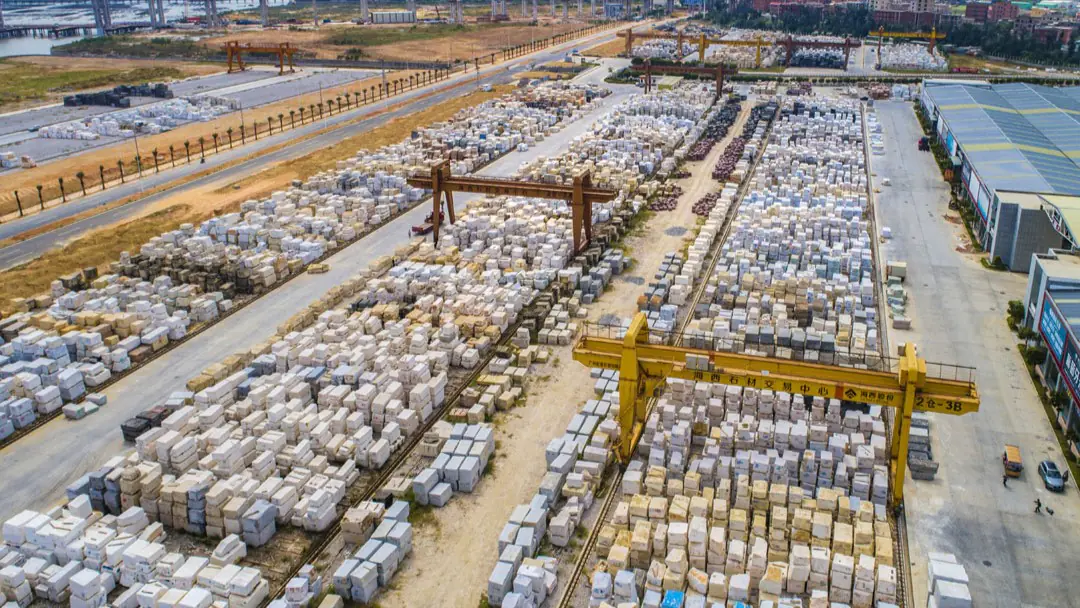
Just north of Jinjiang, Nan’an has the largest stone industry in Southeast Asia. Shuitou Town in Nan’an is the largest stone production and export base in China and even Southeast Asia.
It has over 1,700 stone enterprises, employing 250,000 people. The stone import and export volume of Quanzhou accounts for 60% and 55% of China’s total, respectively. The products are sold to over 140 countries around the world, with a market share of over 70% in the global stone trade.
Nan’an is also a major base for water heating and kitchen products. It is one of the three major water heating production bases in China, with a large number of enterprises producing high-quality kitchen and bathroom products for global markets.
Dehua & Anxi: Ceramics & Tea
Dehua, a county in Quanzhou, is famous for its ceramics industry. It has over 4,000 ceramic enterprises, and the export ratio of its products ranks top in China. Its craft ceramics account for over 60% of China’s craft ceramics export market share. The products are sold to over 190 countries and regions around the world.
Anxi, another county, is the home of Tieguanyin tea. The tea industry here has an annual output of 110,000 tons, and the total output value of the tea industry is expected to exceed 500 billion yuan by 2025. Tieguanyin tea is one of the most famous Chinese tea brands in the world, exported to tea lovers across the globe.
Quanzhou also has a strong food industry, with famous brands like Panpan and Dali, which produce popular leisure food exported to Southeast Asia and the rest of the world. Together, these industries make Quanzhou the core of Global Sourcing from Fujian.
Chapter 3: Xiamen Metropolitan Belt: High-end Manufacturing & Premium Consumer Goods
Just south of Quanzhou, we have Xiamen, the special economic zone of Fujian. This area focuses on high-end manufacturing and premium consumer goods, with a set of high-value export industries.
It is a top spot for buyers looking for high-quality, high-standard products that meet Western market requirements.
High-end Manufacturing & Premium Products
Xiamen is the global high-end sanitary ware production base. Its water heating and kitchen industry has an annual output value of 33 billion yuan. The products are sold to over 180 countries and regions around the world. It has 270 production enterprises, including 4 of China’s 7 listed companies in the water heating industry, like Jianlin Home, Gold Cabinet, which are well-known global brands.
Tong’an District in Xiamen is Asia’s largest fitness equipment manufacturing and export base. It has gathered a large number of fitness equipment enterprises, with a complete industry chain from R&D to production to sales. The products are exported to over 100 countries and regions around the world, supplying gyms and home users across the globe.
Xiamen also has a strong power and electrical industry. It has world-leading enterprises like Schneider, ABB, and KEHUA Data. The industry scale ranks top 10 in China’s power transmission and distribution industry.
Optical & Food Industry
Xiamen is also known as “China’s Sunglasses Production Base”. It is one of the five major glasses production bases in China. The high-end sunglasses products here account for over 80% of the domestic market. It has over 200 glasses production enterprises, with an annual output value of over 10 billion yuan.
The food industry in Xiamen is also very strong. It has a large number of well-known brands, like Anjoy Food, Yinlu, Yanzhiwu, Haidi Tea, which produce popular food products exported to the world. These brands have rich export experience, meeting the food safety standards of different countries.
Xiamen is also the birthplace of many of China’s top sportswear brands, like Septwolves, Anta, Xtep, 361°, which started here and expanded to the global market. These brands have rich experience in exporting to Western markets, so they know how to meet the high quality standards of global buyers.
Chapter 4: Fuzhou & Putian Specialty Belt: Home Goods, Shoes & Crafts
To the north of Xiamen, we have Fuzhou and Putian, two cities with their own unique specialty industries. These areas focus on daily use home goods and craft products, dominating many global niche markets.
If you are sourcing daily use products, home decor, or craft products, this is the region you need to know.
Fuzhou’s Home Goods & Specialty Products
Fuzhou, the capital of Fujian, has a set of unique home goods industries. Changle District has a strong textile industry, with a complete industry chain from petrochemical fiber to finished clothing. It is one of the major textile bases in China.
Fuqing has a strong machinery manufacturing industry, especially the auto glass industry. Fuzhou has the world’s largest auto glass smart factory, supplying high-quality auto glass to global car manufacturers. Fuzhou’s metallurgy industry is also very strong, with stainless steel output accounting for 30% of China’s total, and tungsten wire for lamps taking up 70% of the national market.
Lianjiang’s daily use home goods industry is one of the largest in China. It has 12,000 manufacturing enterprises, and the production and export volume ranks top in the country. The products are sold to over 150 countries around the world. Minhou’s home craft industry is the largest home decor craft production base in China, with 660 enterprises, and an annual turnover of over 7 billion yuan.
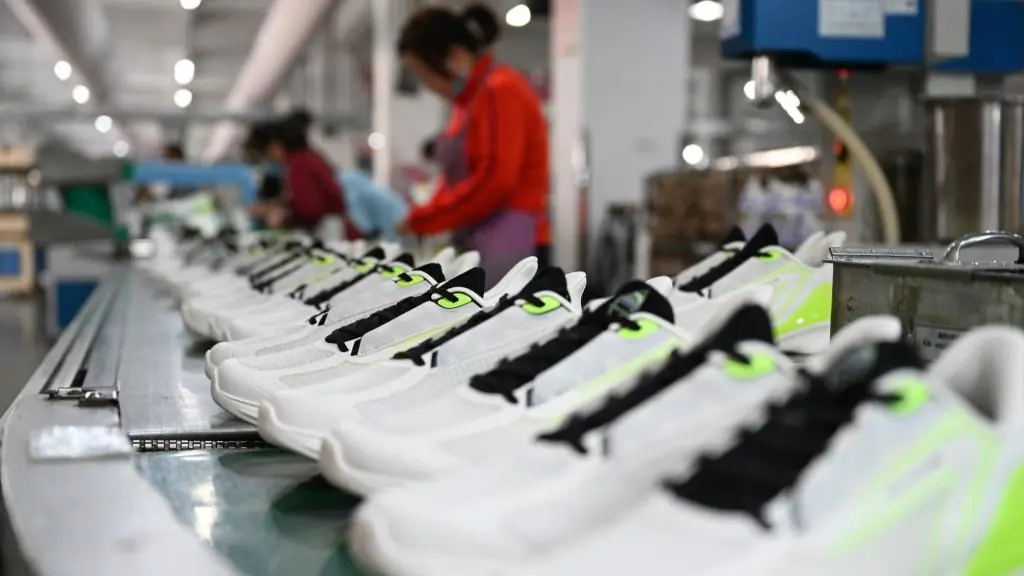
The most famous product from Fuzhou is the injection molding slippers. Fuzhou is the largest injection slippers export base in the world. It has 1,677 shoe enterprises, including 838 production factories. Most of the flip-flops in the world are made in Fuzhou.
Fuzhou also has many characteristic agricultural export products. Fuzhou is the birthplace and main production area of jasmine tea, whose production technology is national intangible cultural heritage. Luoyuan’s edible fungi industry, the Pleurotus geesteran output accounts for nearly 60% of the national output.
Putian’s Shoes & Crafts
Putian, next to Fuzhou, is another famous shoe production base in Fujian. It is known as “China’s Shoe Capital”, and it is an important production base for world-famous sports shoe brands. Many international brands like Adidas, Puma, Nike have production bases here.
The shoe and apparel industry in Putian has a scale of over 120 billion yuan, with over 4,000 large and small enterprises. These factories have rich OEM experience, so they can produce high-quality shoes that meet international brand standards.
Putian’s arts and crafts industry is also very strong. It has over 7,000 production enterprises, covering wood carving, stone carving, oil painting, gold and silver jewelry. The industry employs over 300,000 people, and the craft products are exported to art buyers around the world.
This entire Fuzhou and Putian belt is focused on light industry products. It is the reason why Fujian is such a big part of China High-end Manufacturing Export Supply Chain, even for traditional light industry products.
Chapter 5: New Energy & Digital Upgrade: Fujian’s New Global Competitive Edge
All these traditional industrial clusters are impressive, but what really makes Fujian stand out today is its new energy and digital transformation. Fujian is not just a traditional manufacturing hub—it is building the global new energy supply chain.
This is what gives it a new competitive edge in the global market.
Ningde: The Global Leader in New Energy Industry
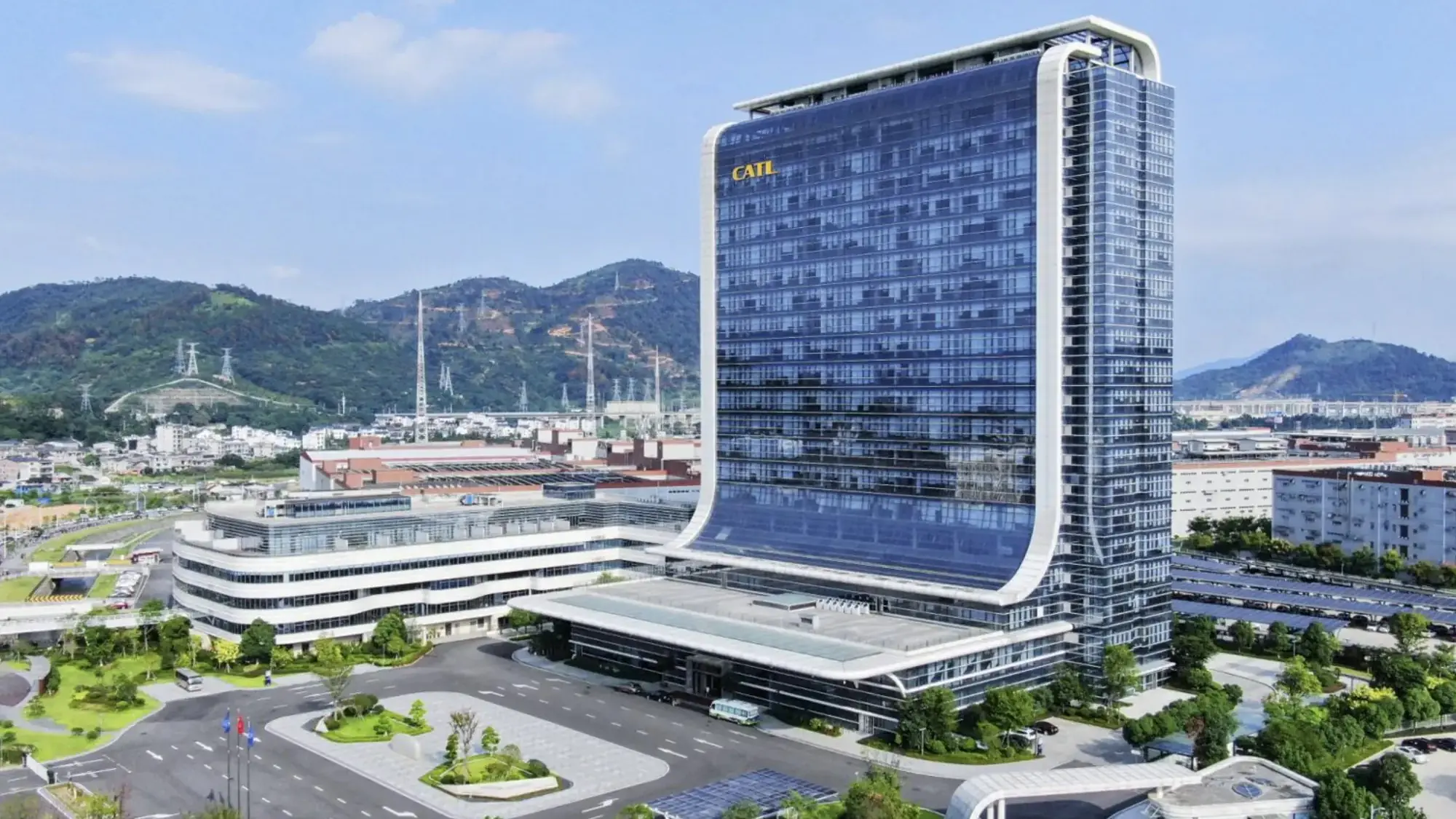
First, Ningde’s new energy industry is leading the world. Ningde has the world’s largest polymer lithium ion battery production base. The new energy industry here has an annual output value of over 270 billion yuan, leading the global industry scale. CATL, the world’s largest lithium battery manufacturer, is based here, supplying batteries to global car manufacturers and energy storage projects.
Ningde also has other strong industries. Its stainless steel new material industry has an output value of over 200 billion yuan. Its small and medium-sized motor output and export volume account for about 33% of the national similar products. The carburetor output accounts for 70% of the national total. It is known as “China’s Small Motor Capital”.
Cross-border E-commerce: Opening Fujian to Global SMBs
Second, Fujian is a leader in cross-border e-commerce. Many of its cities are national cross-border e-commerce pilot zones. This means that small buyers can now source directly from Fujian factories online, without having to travel to China.
This has opened up Fujian’s industrial clusters to small and medium businesses around the world. Before, only large companies could afford to source directly from China. Now, even a small store owner can order a small batch of goods from Jinjiang or Dehua through cross-border e-commerce.
From OEM to Global Brands: Fujian’s Industrial Upgrade
Third, Fujian’s factories are upgrading from OEM to independent brands. Unlike many other regions that only do processing for foreign brands, Fujian has built many global brands. For example, Anta is now the second largest sportswear brand in the world. CATL is the global leader in new energy batteries. These brands are not just cheap goods—they are high-quality, innovative products that compete with Western brands.
This means that sourcing from Fujian is now easier and more reliable than ever. You can get high-quality products, fast delivery, and competitive prices, whether you are a large company or a small business. This is why Cross-border E-commerce in Fujian is growing so fast.
Practical Sourcing Guide: How to Get the Best Results From Fujian’s Clusters
Now that you know what Fujian’s industrial clusters can offer, you might be wondering how to actually source products from these regions. Sourcing from Fujian is not hard, but there are a few practical tips that can help you avoid common mistakes and get the best price and quality for your business.
Tip 1: Choose the Right Town for Your Product
First, pick the right town for your specific product. Many new buyers make the mistake of contacting random suppliers across the province, thinking a “general manufacturer” can give them the best deal. But as we have shown, each town in Fujian specializes in one specific product, and built a complete supply chain around it.
If you want to source sports shoes, you have two options: if you need branded quality shoes, go to Jinjiang. If you need OEM production for international brands, go to Putian. If you need craft ceramics, go straight to Dehua. This way, you can access the full local supply chain, and get a price that is 30-40% lower than sourcing from general suppliers, because the local factories do not have to pay for shipping parts from other cities. That cost saving gets passed directly to you.

Tip 2: Verify Supplier’s Export Experience
Second, verify your supplier’s export experience before placing an order. Fujian has tens of thousands of factories, but not all of them have experience exporting to Western markets. Many of them are very familiar with the Southeast Asian market, which is their traditional trade partner, but if you are selling to Europe or the US, you need to confirm they can meet your local standards.
For example, if you are sourcing sanitary ware, you need to make sure the factory has the CE or UPC certifications. If you are sourcing food products, you need to confirm they can meet FDA or EU food safety standards. A good export-experienced supplier will already have these certificates ready, and can share them with you in one day.
Tip 3: Small Batch Orders Are Available
Third, do not assume Fujian’s factories only do huge bulk orders. Many small business owners think that because Fujian has such large industrial clusters, the factories only take orders of 10,000 units or more. That is a big misunderstanding.
Most of the specialized towns in Fujian have many small and medium-sized factories that can handle small batch orders. For example, many Dehua ceramics factories can handle orders of 500 pieces or less, perfect for small home decor stores. Many Fuzhou slippers factories can do small custom orders for cross-border e-commerce sellers, even if you only need 1000 pairs of slippers.
If you are a small buyer, just tell the supplier your order size upfront. Most of them are happy to work with small businesses, especially if you can commit to repeat orders in the future.
Tip 4: Plan Shipping & Logistics Wisely
Fourth, plan your shipping and logistics properly. Fujian has one of the best logistics infrastructures in China, especially for trade with Southeast Asia. Most of the industrial clusters are within 2 hours of Xiamen Port or Fuzhou Port, two of the largest ports in the world. That means your goods can get from the factory to the port in just 1-2 days after production, no long internal trucking needed.
You also have many shipping options to choose from. For large bulk orders, sea freight from Xiamen Port is the cheapest option, with delivery to Southeast Asia in just 3-7 days, and to Europe or the US in 30-40 days. For small orders, you can use cross-border e-commerce logistics, which can deliver your goods to your door in 7-15 days.
Most suppliers in Fujian can also help you arrange the shipping. They have long-term partnerships with local freight forwarders, so they can get you a better price than you can get on your own. That saves you the trouble of arranging shipping yourself.
Tip 5: Plan Ahead for Chinese Public Holidays
Fifth, plan ahead for Chinese public holidays. This is one of the most common mistakes new buyers make. The biggest holiday is the Spring Festival, usually in February. During that time, most factories close for 1-2 weeks, and some close for even longer to let workers go home for family reunions. Production stops completely, and shipping slows down a lot.
If you have an order that needs to be done before Spring Festival, you need to place the order at least 2 months in advance. That gives the factory enough time to finish production and ship the goods before the holiday. Other holidays like National Day in October also cause short slowdowns, so plan your order schedule accordingly.
Conclusion
Fujian’s foreign trade industry chain is a perfect example of how China’s manufacturing is upgrading. Its industrial clusters cover everything from cutting-edge new energy batteries to everyday consumer goods.
From Quanzhou’s shoes and stone to Xiamen’s high-end products, from Fuzhou’s home goods to Ningde’s new energy, each region has perfected its craft. They have built complete supply chains that are fast, efficient, and cost-effective.
For global buyers, this makes Fujian the best place in the world to source almost any product. Whether you are a small business owner looking for small batches or a large company looking for massive bulk orders, you can find what you need here.
As Fujian continues to upgrade its industries and build global brands, it will only become more important in the global supply chain. It is the maritime gateway of China’s Foreign Trade Industry Chain, and it will keep powering global trade for years to come.
If you are looking to source products from China, start with Fujian. You will be amazed at what you can find.