
Most Yiwu agents charge one of two ways: a percentage commission on the value of your order, or a flat fee or monthly retainer for ongoing work. Neither structure is automatically better. The right question isn’t “which is cheaper on paper” but “which one, once you add up everything included, gets my goods to my warehouse for the lowest total cost with the least risk.” This guide is part of a complete guide to Yiwu agents, which covers what an agent does before you get to what they charge.
Buyers who fixate on the headline percentage often miss the bigger risk: an agent advertising “0% commission” or a suspiciously low rate isn’t necessarily cheaper. In many cases they’re recovering their margin through supplier kickbacks you never see on an invoice, which usually costs you more than a transparent commission would.
Key Takeaways
- Yiwu agents typically charge either a commission on order value or a flat fee/retainer for recurring work; the right choice depends on order frequency and predictability.
- Commission rates commonly cited across sourcing-industry coverage fall in the 3% to 10% range, with rates generally trending lower as order value scales up. No independent, audited data source publishes this range; it’s an industry convention repeated across sourcing-agency blogs, not a verified statistic, so treat it as a starting point rather than a guaranteed quote.
- A standard commission should cover sourcing, negotiation, quality inspection, consolidation, and shipping coordination, not just introducing you to a supplier.
- An agent offering an unusually low or “free” commission is a red flag for hidden markup built into supplier pricing rather than genuine savings.
- Compare total landed cost, not just the fee percentage, since a higher visible commission can still produce a lower all-in price.
How Do Yiwu Agents Charge: Commission or Flat Fee?
Yiwu agents generally price their services one of two ways: a percentage commission calculated on the value of each order, or a flat fee or monthly retainer that doesn’t move with order size.
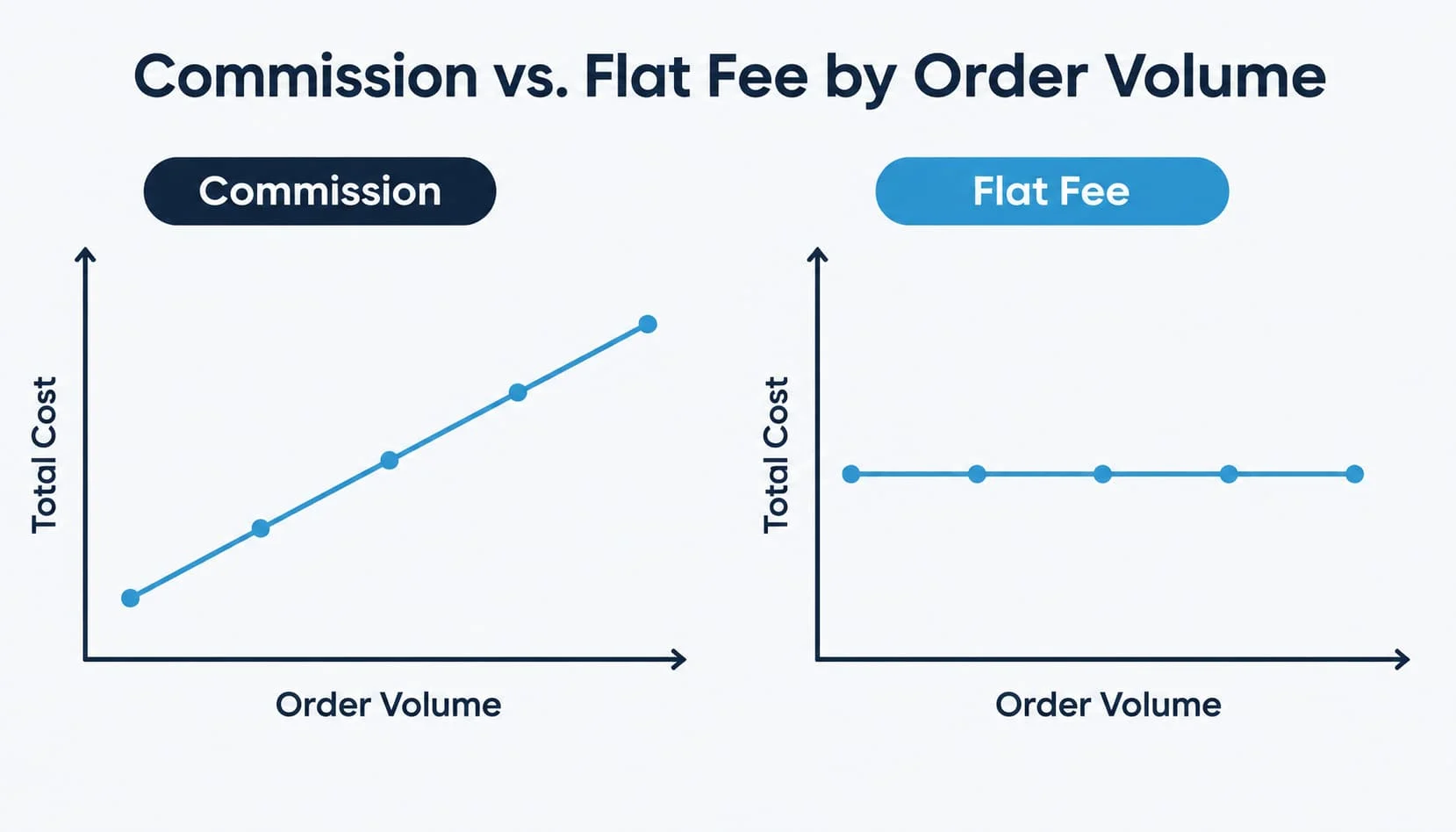
Commission-based pricing is the default for buyers who order occasionally, in variable amounts, or who are still building a relationship with an agent. The agent takes a cut of whatever the order is worth, so the fee scales with volume automatically and there’s no fixed cost to negotiate upfront. Coverage of China sourcing services from China Briefing and other industry sourcing publications describes typical commissions in the 3% to 10% range, with the exact rate shaped by order size, product complexity, and how much inspection and consolidation work the order requires. Worth flagging up front: that range comes from sourcing-agency blogs describing their own industry’s pricing, not from an independent, audited source, so treat it as a directional convention rather than a verified figure (more on that at the end of this article). As one data point on how this plays out at a single agency, Union Trust structures its own commission between 3% and 6% depending on the client’s order profile, which sits within that broader range.
Flat-fee and retainer pricing suits a different buyer: one placing frequent, fairly predictable orders where a fixed monthly cost is easier to plan around than a percentage that shifts with every shipment. These arrangements are less common for first-time buyers because most agents want an established track record before offering a fixed rate; the agent is effectively betting that your order volume will be steady enough to make the fixed number work for both sides.
Neither model is inherently the cheaper option. A flat fee saves money once your order volume passes a certain threshold, because the fee stops growing while the order size keeps growing. Below that threshold, commission is usually the better deal, because you’re not paying a fixed cost against a small order.
Why Does Commission Vary by Order Size?
Commission tends to run higher on smaller orders and lower on larger ones, and the reason comes down to fixed workload versus scaling revenue.
Finding a supplier, negotiating price, arranging one round of quality inspection, and booking one shipment takes roughly the same amount of agent time whether the order is worth $2,000 or $20,000. On a small order, a fixed workload against a small order value pushes the effective percentage up, because the agent still needs to earn enough to justify the hours spent. On a larger order, the same workload gets spread across a bigger number, so the percentage the agent needs to charge to stay profitable goes down.
This is the mechanism behind the general pattern that larger, simpler orders sit toward the lower end of the typical commission range while smaller or more complex orders (many SKUs, multiple vendors, extra QC steps) sit toward the higher end. If a quoted rate doesn’t roughly track with this logic, for example a very small trial order priced at a very low commission, it’s worth asking directly what’s included, since an unusually low rate on a small order is one of the situations where hidden costs elsewhere become more likely.
What Does the Fee Actually Cover?
A legitimate Yiwu agent commission should cover four core functions: sourcing and supplier negotiation, quality control and inspection, consolidation of multiple vendor shipments into one, and coordination of freight and export documentation.
Sourcing and negotiation is the most visible part: the agent identifies which booths or factories carry what you want, requests and compares samples, and negotiates price on your behalf. Quality control means someone checks the goods against your specification before they ship, catching problems while they’re still cheap to fix rather than after a container has landed in your country. Consolidation matters most for buyers ordering from many small vendors at once; without it, you’d be paying separate freight on twenty small parcels instead of one combined shipment. Shipping coordination covers booking freight, preparing export paperwork, and liaising with your customs broker on the receiving end.
Before agreeing to a rate, ask which of these four functions are actually included and which cost extra. Some agents quote a low headline commission but bill quality inspection, warehousing, or documentation as separate line items. That’s not necessarily dishonest, but it means the low headline number isn’t the number that matters. What matters is the total cost of getting your goods from a Yiwu booth to your warehouse door, and that total should be the basis for comparing one agent’s quote against another’s, a comparison covered in more depth in Yiwu Sourcing Agent vs Alibaba: Which Actually Saves You Money.
What’s the Catch with a “Free” or Very Low-Commission Agent?
An agent advertising no commission, or a rate well below what the rest of the market charges for comparable work, is usually recovering that margin somewhere you can’t see it, most often through a markup baked into the supplier’s quoted price rather than through a fee on your invoice.
Here’s how that typically works. The agent has a relationship with a supplier and arranges for the supplier to quote you a price that’s inflated above what a direct buyer would pay, then the agent takes a cut of that inflated amount as a kickback from the supplier rather than a visible commission from you. You never see this on paper because it’s baked into unit price, not itemized as a fee. The practical effect is the same as paying commission, except you can’t verify the rate, you can’t negotiate it, and you have no way of knowing whether you’re paying 5% extra or 25% extra, because the markup is invisible by design.
This arrangement isn’t automatically a scam, but it removes your ability to compare costs and puts the agent’s financial incentive at odds with getting you the best supplier price. A transparent commission gives you a number you can negotiate and audit against the invoice. A hidden markup gives you neither, and it’s exactly the kind of arrangement covered in Yiwu Agent Scams: 12 Red Flags and How to Verify an Agent Is Real, since a too-good-to-be-true low or absent commission is one of the clearer warning signs on that list.
How Do You Compare Total Cost, Not Just the Headline Rate?
Compare agents on total landed cost per unit, not on the commission percentage in isolation, because a higher visible commission from a transparent agent can still beat a lower or hidden rate from one that isn’t.
Start by asking each agent for a full breakdown: the ex-factory or supplier quote, the commission or fee, inspection costs if billed separately, consolidation and warehousing charges, and freight to your destination. Add all of it up and divide by the quantity ordered to get a true landed cost per unit. That number, not the percentage on its own, is what actually determines whether an agent is a good deal.
It also helps to get an independent sense of what the supplier price should look like before the agent’s fee. Requesting a quote directly from a comparable supplier listing on Alibaba, even if you don’t intend to order that way, gives you a rough benchmark to check an agent’s stated supplier cost against. The tradeoffs of that comparison, including what you give up by skipping an agent entirely, are covered in Yiwu Sourcing Agent vs Alibaba. It’s also worth confirming you’re actually comparing an agent to an agent and not to a different business model altogether; a trading company that holds its own inventory prices very differently than a sourcing agent working the open market, a distinction explained in Yiwu Agent vs Sourcing Agent vs Trading Company: Which One Do You Need.
Methodology note: the commission ranges referenced in this article reflect figures reported in general sourcing-industry coverage and one agency’s disclosed rate structure, not an independent industry-wide audit. Actual rates vary by agent, order complexity, and negotiation, and buyers should confirm the exact rate and scope in writing before placing an order rather than relying on published ranges alone.
Frequently Asked Questions
What’s a normal commission rate for a Yiwu agent?
Commission-based agents commonly charge in the 3% to 10% range of order value, with larger and simpler orders typically toward the lower end and smaller or more complex orders higher. Get the exact rate and what it covers confirmed in writing before you place an order.
Is flat-rate pricing better than commission?
It depends on your order volume. Flat-fee or retainer pricing tends to work out cheaper once your order size or frequency passes a certain point, because the fee doesn’t grow with the order. For smaller or occasional orders, commission usually costs less overall since you’re not paying a fixed amount against a small purchase.
Should I avoid an agent that charges no commission at all?
Treat it as a question to ask rather than an automatic disqualifier, but be cautious. A genuinely free-to-the-buyer arrangement is uncommon in this business, and the most likely explanation is that the agent is earning through a markup built into the supplier’s price instead of a visible fee. Ask directly how the agent is compensated before proceeding.
Does the commission include quality inspection and shipping?
It should, but not every agent structures it that way by default. Confirm specifically whether sourcing, inspection, consolidation, and freight coordination are all included in the quoted rate, or whether any of them are billed as separate charges, before you compare one quote against another.
The Bottom Line
The commission percentage on a quote is only useful once you know what it’s calculated against and what it includes. A transparent agent charging a higher rate on a genuine supplier price will often beat a lower or absent commission built on a marked-up quote you can’t verify. Ask for an itemized breakdown, calculate total landed cost per unit, and treat an unusually low or missing commission as a question to investigate rather than a bargain to accept.
If you’re still deciding whether an agent is worth the fee at all compared to buying direct, Yiwu Sourcing Agent vs Alibaba: Which Actually Saves You Money walks through the total cost comparison in more detail, and the pillar guide to Yiwu agents covers what to check before you commit to any agent at all.