

A Yiwu agent is a local representative, either an individual or a company, who sources products on your behalf from Yiwu International Trade City and the surrounding factories in Zhejiang province. The agent finds suppliers, negotiates price and minimum order quantity, checks product quality before shipment, consolidates multiple orders into one shipment, and arranges freight and customs paperwork so a buyer overseas never has to set foot in China.
That single sentence answers the question most people type into Google, but it leaves out the parts that actually matter once you’re deciding whether to hire one: how much it costs, how to tell a real agent from a reseller with a nice website, and whether your order is even big enough to justify using an agent instead of buying directly on Alibaba or flying to Yiwu yourself. This guide covers all of it, and links out to more detailed articles on each subtopic as you go.
Key Takeaways
- A Yiwu agent handles sourcing, negotiation, quality inspection, consolidation, and shipping for buyers who can’t visit Yiwu Market in person.
- Yiwu International Trade City, the market most agents work out of, spans an estimated 4 to 6.4 million square meters depending on the source, with more than 75,000 booths and upward of 2.1 million types of products, according to figures published by its operator, Yiwu China Commodities City Group.
- Commission-based agents commonly charge 3% to 10% of order value; flat-fee and retainer models exist for buyers with recurring or larger orders.
- Small buyers, first-time importers, and buyers ordering across many small-batch categories benefit most from an agent; large buyers with a single factory relationship and in-house QC often don’t need one.
- Vetting an agent before paying anything (business license, verifiable client history, transparent fee structure) is the single biggest factor in avoiding a bad experience.
In This Guide
This pillar page is the hub for a full set of articles on Yiwu sourcing. If you already know what you’re looking for, jump straight to it:
- How to Find a Good Yiwu Agent: A Step-by-Step Vetting Process
- Yiwu Agent Scams: 12 Red Flags and How to Verify an Agent Is Real
- Best Yiwu Agent for Small Businesses: What to Look For in 2026
- Yiwu Agent Fees and Commission Explained: What You Should Actually Pay
- Yiwu Sourcing Agent vs Alibaba: Which Actually Saves You Money
- Yiwu Agent vs Sourcing Agent vs Trading Company: Which One Do You Need
- Yiwu Agent for Amazon FBA Sellers: Sourcing to Fulfillment Center
- Low MOQ Yiwu Sourcing: How a Yiwu Agent Helps Small Orders
- Yiwu Sourcing Agent for European Importers: Duties, Freight, and Language
- Visiting Yiwu Market Without an Agent: What You Gain and What You Risk
- How to Buy from Yiwu Market: A First-Timer’s Guide (With or Without an Agent)
What Is a Yiwu Agent?
A Yiwu agent is someone who works on the ground in Yiwu, China, to source and manage orders for buyers who aren’t physically there. The role sits between “translator who walks you around the market” and “full-service sourcing company,” and the range within that spectrum is wide.
At the simple end, an agent is an individual who speaks the buyer’s language and the local dialect, walks the market floor with a visiting buyer, negotiates prices at each booth, and takes a small fee or a flat day rate. At the other end, an agent is a registered company with a warehouse, a quality control team, freight forwarding licenses, and account managers who never require the buyer to visit China at all. Most people searching for “yiwu agent” want the second kind: someone who can handle sourcing, inspection, and shipping remotely, order after order, without them ever getting on a plane.
The distinction matters because the word “agent” gets used loosely. Some operations calling themselves agents are actually resellers marking up wholesale prices without disclosing it, and some are trading companies that only carry their own inventory rather than sourcing from the wider market. The comparison in Yiwu Agent vs Sourcing Agent vs Trading Company breaks down exactly how these business models differ and why the difference affects your price.
What Is Yiwu Market?
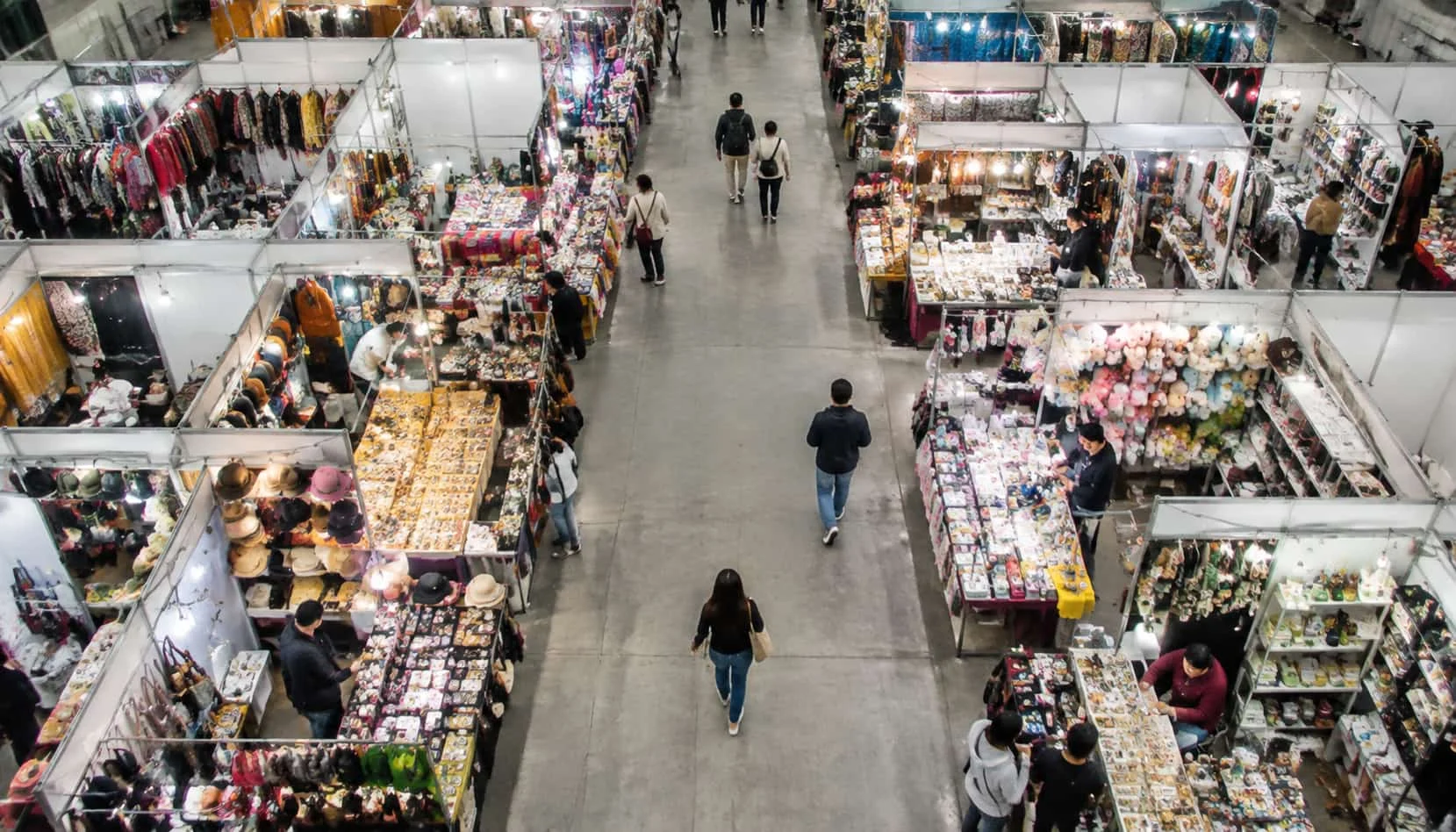
Yiwu Market, formally Yiwu International Trade City, is the wholesale market complex that gives Yiwu agents their reason to exist. It’s the largest small-commodity wholesale market in the world, and it’s the reason a city of nearly 1.9 million people (1,859,390 at the 2020 census) in Zhejiang province exports to buyers on every continent.
Yiwu China Commodities City Group, the state-linked company that operates the market, puts the total floor space somewhere between 4 and 6.4 million square meters, depending on the source and what’s counted as core market space. More consistent are the other two headline numbers: over 75,000 booths, and upward of 2.1 million types of products, spanning categories from jewelry and toys to stationery, home decor, hardware, electronics accessories, apparel, and holiday goods. Those two figures show up the same way across independent coverage, including Xinhua, China Daily, and industry research from Daxue Consulting, which is why the floor-space number gets a range here and the other two don’t.
The market is organized into five interconnected districts, each covering different product categories, and most first-time visitors underestimate how long it takes to walk even one district properly. This is one reason buyers hire agents rather than attempting the market cold: without local knowledge of which district and which floor carries a given product, a visit can burn days without results. How to Buy from Yiwu Market walks through the market’s layout and how to navigate it, whether or not you’re using an agent.
Methodology note: market size and booth-count figures are self-reported by the market operator and repeated across secondary press coverage; they represent the market’s own stated capacity rather than an independently audited count, and buyers should treat them as directionally accurate rather than exact.
What Services Does a Yiwu Agent Actually Provide?
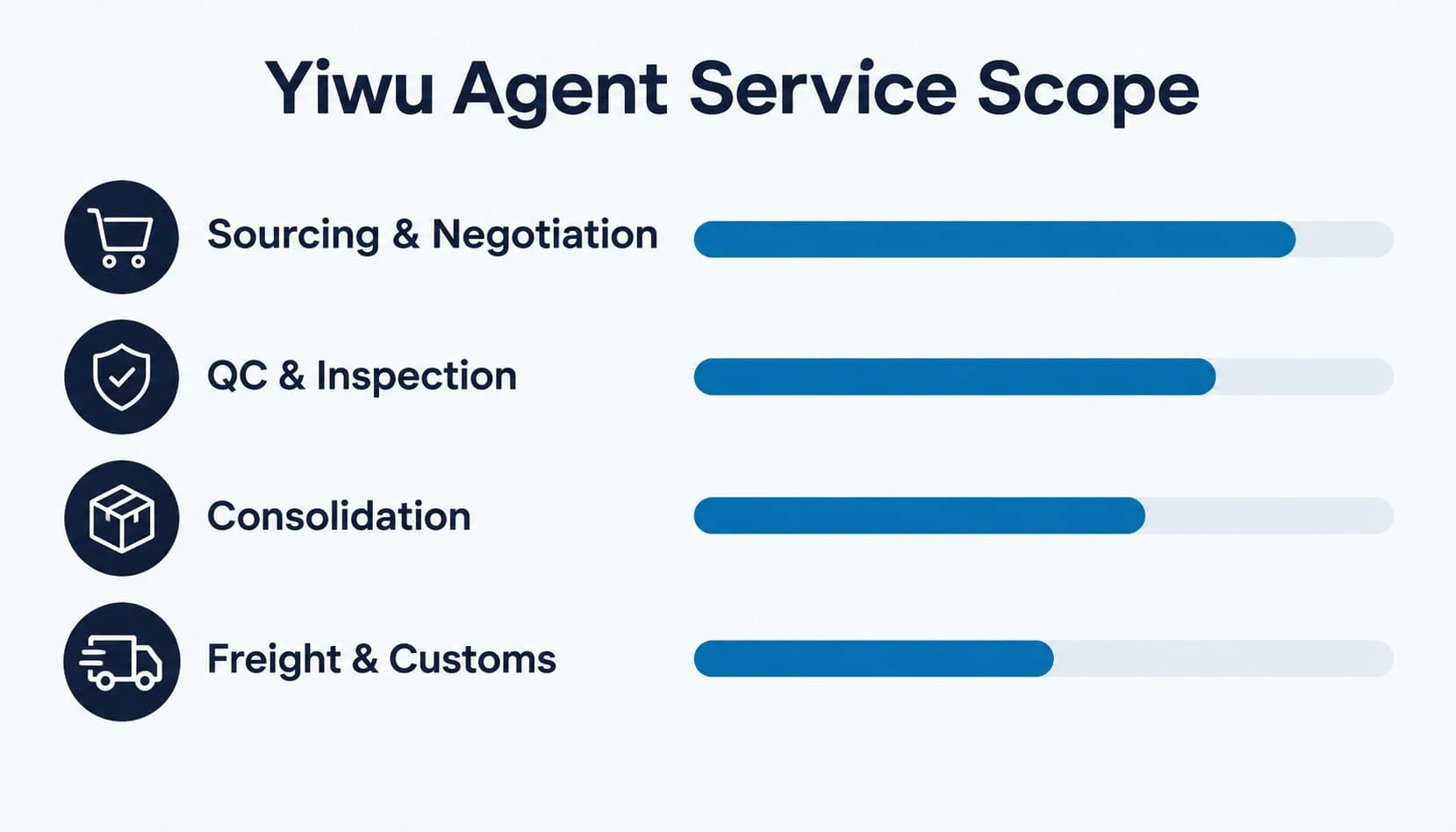
A full-service Yiwu agent covers everything between “I want to sell this product” and “the product is in my warehouse,” which breaks down into four distinct functions.
Supplier Sourcing and Negotiation
The agent identifies which booths or factories carry the product a buyer wants, requests samples, compares pricing across multiple vendors, and negotiates on the buyer’s behalf. Because pricing at Yiwu Market is rarely fixed, a local negotiator who knows typical margins for a product category can often secure a lower unit price than a foreign buyer negotiating alone, simply because vendors price differently once they identify a buyer as a first-time visitor rather than a repeat local trader.
Quality Control and Inspection
Before an order ships, the agent (or a QC team the agent contracts) checks the goods against the buyer’s specification: correct materials, correct color and size distribution, working mechanisms for anything electronic or mechanical, and packaging integrity. This step catches problems while they’re still fixable, rather than after a container has landed in the buyer’s home country. A defect caught before shipment is a quick fix; the same defect caught after customs clearance is a much more expensive problem, and that gap is basically the whole case for using an agent instead of ordering blind online.
Consolidation and Warehousing
Because Yiwu buyers frequently order small quantities from many different vendors, a single order might involve goods from twenty or more separate booths. The agent collects all of it into one warehouse, repacks it into export cartons, and consolidates it into a single shipment rather than twenty separate ones. This single function is often what makes small-order sourcing viable at all: without consolidation, shipping twenty tiny parcels separately would cost more than the goods themselves.
Shipping, Freight, and Customs
The agent (directly or through a freight forwarding partner) books ocean or air freight, prepares the export documentation, and coordinates with the buyer’s customs broker on the receiving end. Buyers who don’t have an existing freight forwarder rely on the agent’s freight network, which is one reason agent selection matters even for buyers who already know exactly what product they want.
How Much Does a Yiwu Agent Cost?
Yiwu agents generally charge under one of three models: a percentage commission on order value, a flat fee per order or per container, or a monthly retainer for buyers who order continuously.
Commission-based pricing is the most common structure for buyers who order occasionally or in variable volumes. Industry coverage of China sourcing services, including guidance from China Briefing and general sourcing-industry publications, describes typical commissions in the range of 3% to 10% of order value, with the rate depending on order size, product complexity, and how much QC and consolidation work is involved. Larger orders tend to sit at the lower end of that range, because the agent’s fixed workload (finding the supplier, negotiating, arranging one shipment) doesn’t scale up in step with order value. Union Trust, for instance, structures its own commission between 3% and 6% depending on client order profile, which sits comfortably inside the range reported across the industry.
Flat-fee and retainer models suit buyers with predictable, recurring orders, where a fixed monthly cost is easier to budget than a percentage that changes with every shipment. These arrangements are less common for first-time buyers because they typically require an established working relationship first.
Whatever the model, a legitimate agent discloses the fee structure before an order is placed, not after. Vague answers about pricing, or a refusal to put commission terms in writing, is one of the clearest signals something is off. The full breakdown of fee structures, typical rates by order size, and how to spot padded or hidden charges is covered in Yiwu Agent Fees and Commission Explained.
Yiwu Agent vs Alibaba vs Trading Company
Buyers new to China sourcing often assume Alibaba, a Yiwu agent, and a trading company are interchangeable ways to get the same product. They’re not, and the differences affect price, speed, and how much oversight the buyer has to do themselves.
Alibaba connects a buyer directly to a supplier’s online storefront, with no local intermediary negotiating or inspecting on the buyer’s behalf. That works well for buyers who already know their product, already trust a specific supplier, and can handle QC and freight themselves or through a separate service. It removes the agent’s commission, but it also removes the agent’s negotiation leverage, sample vetting, and pre-shipment inspection. Yiwu Sourcing Agent vs Alibaba compares total landed cost between the two approaches across several order scenarios.
A trading company, by contrast, holds its own inventory or has fixed relationships with a limited set of factories, and sells at a marked-up price without necessarily disclosing the markup or offering the flexibility to source from the wider market. A Yiwu agent, done properly, sits between these two: it offers the market access of Alibaba-style sourcing with the negotiation, inspection, and consolidation services a buyer would otherwise have to arrange separately. The full three-way comparison, including when each model actually makes financial sense, is in Yiwu Agent vs Sourcing Agent vs Trading Company.
Who Should Use a Yiwu Agent (and Who Shouldn’t)
A Yiwu agent makes the most sense for buyers who fit one or more of these situations: first-time importers unfamiliar with Chinese supplier vetting, buyers ordering small quantities across many product categories rather than one large order from one factory, buyers with no existing freight forwarder or customs broker relationship, and buyers who can’t travel to China themselves but need product inspected before it ships.
An agent makes less sense for buyers who already have a direct, trusted factory relationship for a single product line, order large enough volumes to negotiate directly with manufacturers, and have in-house or contracted QC and freight capability. For that profile, an agent’s commission adds cost without adding much the buyer can’t already do.
Two buyer profiles come up often enough to warrant their own detailed treatment. Amazon FBA sellers have specific needs around packaging compliance, labeling, and shipping directly to fulfillment centers, covered in Yiwu Agent for Amazon FBA Sellers. Buyers placing very small orders, sometimes just a handful of SKUs at low quantity, face a different set of constraints around minimum order quantities and per-unit freight cost, covered in Low MOQ Yiwu Sourcing. European importers also face a distinct set of considerations around duties, freight routing, and language, addressed in Yiwu Sourcing Agent for European Importers.
How to Choose a Yiwu Agent Safely
Choosing an agent poorly is the single most common way buyers lose money in this process, and it’s almost always preventable with basic verification steps before any payment changes hands.
At minimum, verify that the agent operates as a registered business with a checkable business license, ask for references from existing clients (and actually contact them), get the fee structure in writing before placing an order, and start with a small trial order before committing to a larger one. Payment terms matter too: an agent asking for full payment upfront, especially to a personal account rather than a business account, is a common pattern in agent scams.
The detailed, step-by-step version of this vetting process, including what documents to request and how to interpret them, is in How to Find a Good Yiwu Agent. If you want the warning signs first, Yiwu Agent Scams: 12 Red Flags catalogs the specific patterns that precede most reported scams, from fake booth photos to payment redirection late in the process. Buyers running a small operation with limited resources for vetting should also read Best Yiwu Agent for Small Businesses, which addresses the specific tradeoffs smaller buyers face when evaluating agents with limited bargaining power.

Visiting Yiwu Without an Agent
Some buyers choose to skip the agent entirely and visit Yiwu Market in person. This works, and plenty of experienced buyers do it, but it comes with tradeoffs that aren’t obvious until you’re standing in a five-district market with no local language ability and a flight home in four days.
The market itself is navigable without an agent if a buyer has time to learn its layout, and doing at least one visit independently gives a buyer a much better sense of real pricing and product range than working entirely through intermediaries. The tradeoff is time: negotiating without local language, finding the right booths without local knowledge of the market’s organization, and arranging your own freight and customs paperwork can turn a one-week trip into a much longer, more expensive one. Visiting Yiwu Market Without an Agent lays out exactly what a buyer gains and gives up by going it alone, and How to Buy from Yiwu Market is a practical first-timer’s walkthrough that applies whether or not an agent is involved.
Frequently Asked Questions
Is it safe to hire a Yiwu agent I found online?
It can be, but only after verification. Confirm the agent has a registered business, ask for and contact existing client references, and avoid any agent that pressures full upfront payment to a personal account. The vetting steps in How to Find a Good Yiwu Agent apply regardless of where you found the agent.
Do I need a Yiwu agent if I’m already ordering through Alibaba?
Not necessarily. If you already trust your Alibaba supplier and have your own QC and freight arrangements, an agent adds a cost you may not need. An agent adds the most value when you’re sourcing from multiple small vendors, need pre-shipment inspection, or lack an existing freight relationship, as covered in Yiwu Sourcing Agent vs Alibaba.
What’s a reasonable commission rate for a Yiwu agent?
Commission-based agents commonly charge 3% to 10% of order value, with larger, simpler orders typically at the lower end and smaller or more complex orders higher. Get the exact rate and what it covers in writing before placing an order. Full detail is in Yiwu Agent Fees and Commission Explained.
Can a Yiwu agent handle shipping to an Amazon FBA warehouse?
Many can, but FBA shipments have specific labeling, packaging, and carton-marking requirements that not every agent handles correctly by default. Confirm FBA experience specifically before booking, as detailed in Yiwu Agent for Amazon FBA Sellers.
The Bottom Line
A Yiwu agent exists to solve a specific problem: you can’t be in Zhejiang province negotiating with 75,000 booths, inspecting goods, and arranging freight, so someone else does it for a fee. Whether that fee is worth paying depends on your order size, your existing supplier relationships, and how much of the sourcing, QC, and logistics work you’re equipped to do yourself.
If you’re weighing that decision for the first time, the next practical step is learning how to tell a competent agent from a risky one before you send a deposit. Start with How to Find a Good Yiwu Agent: A Step-by-Step Vetting Process, and keep Yiwu Agent Scams: 12 Red Flags open alongside it while you evaluate your options.