

There is no single “best” Yiwu agent for every small business, because the agent that works well for a buyer ordering one container a year looks nothing like the one that works for a buyer testing five new SKUs a month. What you actually need is a way to evaluate any agent against the constraints small buyers specifically face: limited order volume, less bargaining power, and less room to absorb a costly mistake.
This guide skips name-and-rank lists of agencies, since a public review naming and grading specific competing businesses isn’t something we’re positioned to do fairly here. Instead, it gives you eight concrete criteria to check against any agent you’re considering, whether you found them through a referral, a directory, or a cold outreach message. what is a Yiwu agent
Key Takeaways
- Small businesses should evaluate Yiwu agents on eight practical criteria: MOQ flexibility, transparent commission, dedicated English-speaking contact, sample-order policy, consolidation support, response-time expectations, room to scale, and pricing without hidden kickbacks.
- Commission-based agents commonly charge 3% to 10% of order value, with the exact rate depending on order size and complexity, according to industry coverage of China sourcing services.
- A low upfront MOQ matters less than whether the agent will actually consolidate small orders from multiple vendors into one affordable shipment, since that’s what makes small-batch sourcing viable at all.
- Getting the fee structure in writing before placing an order is the single check that prevents most of the bad experiences small buyers report.
Why “Best” Depends on Your Order Size
A large importer negotiating directly with one factory has leverage a small business doesn’t have, and that changes what “good service” even means. Small buyers typically order across more product categories at lower volume per category, which means the value an agent adds is less about squeezing the last cent out of a unit price and more about making a small, fragmented order logistically and financially workable at all.
That reframes the evaluation. Instead of asking “which agent gets me the lowest price,” a small business should ask “which agent’s structure actually fits how I buy.” The eight criteria below cover that fit directly. For a step-by-step process on verifying any agent’s legitimacy before you send money, see How to Find a Good Yiwu Agent.

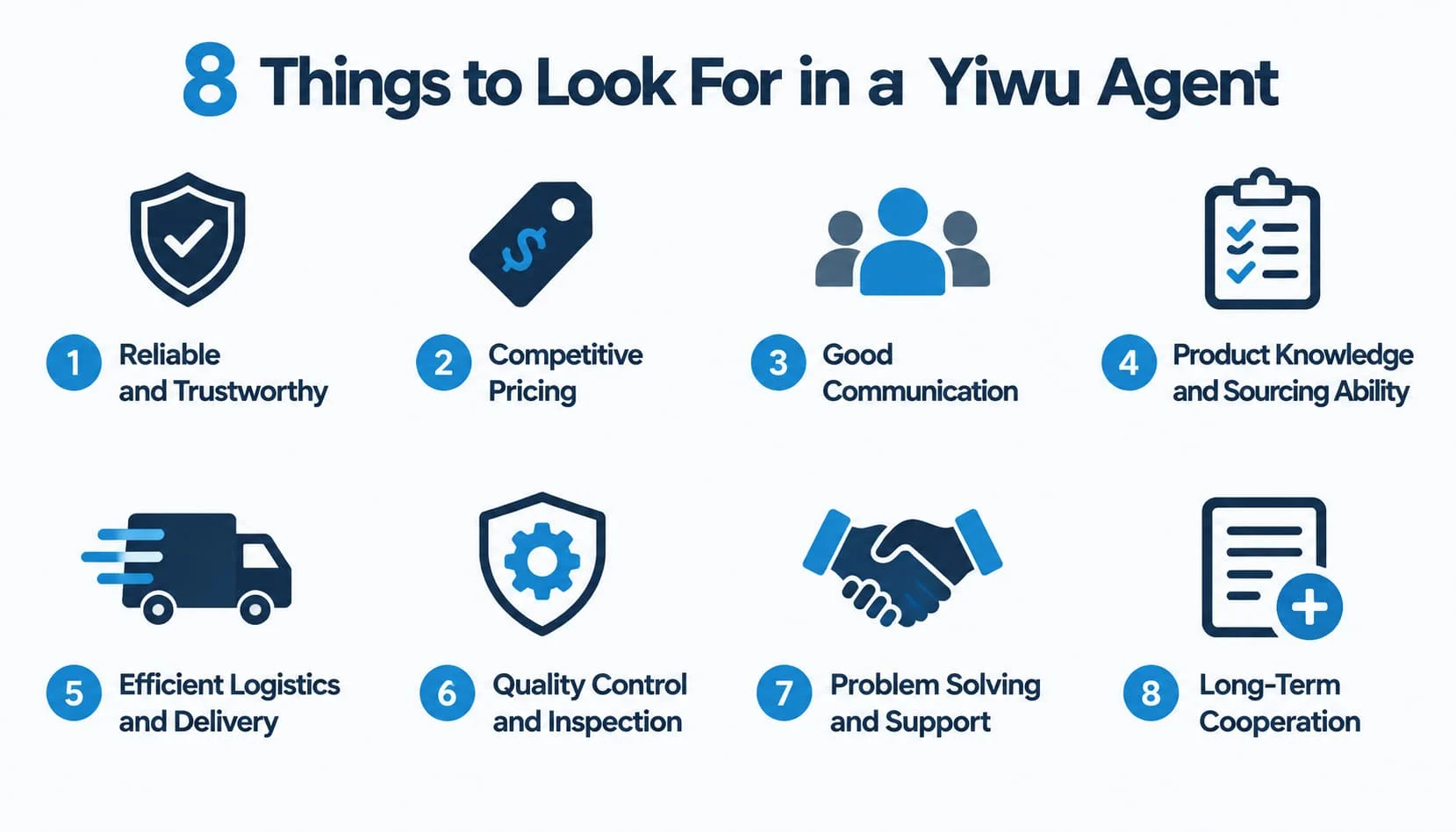
8 Things a Small Business Should Look for in a Yiwu Agent
1. Low or Flexible MOQ Policy
Check whether the agent can work with per-item minimum order quantities that suit a small buyer, not just the factory-standard MOQ. Many Yiwu vendors set MOQs designed for wholesale-volume buyers, and an agent who can negotiate a lower quantity, or blend a small order with other buyers’ orders for the same product, opens up categories a solo small buyer couldn’t access alone.
Ask directly what MOQ range the agent has actually secured for buyers your size in the past twelve months, not what the agent’s marketing page claims is possible in general.
2. Transparent, Capped Commission Structure
The agent should tell you the commission rate, what it’s calculated on, and whether it’s capped, before you place an order, not after goods have shipped. Industry coverage of China sourcing services, including guidance from China Briefing, describes typical commission rates in the range of 3% to 10% of order value, with the exact figure depending on order size and how much QC and consolidation work is involved.
A small order at the higher end of that range isn’t automatically a red flag, since fixed workload (sourcing, negotiating, arranging one shipment) doesn’t shrink proportionally with order size. What matters is whether the rate is disclosed and fixed in writing, not whether it’s the absolute lowest number you can find. For the full breakdown of pricing models and how to compare them, see Yiwu Agent Fees and Commission Explained.
3. A Dedicated, Responsive Contact Who Speaks Your Language
For a small business, losing a week to a language mix-up on a $2,000 order hurts a lot more than the same delay on a $200,000 order. Confirm you’ll have one named contact, not a rotating pool of staff, and that the contact communicates fluently in your working language, whether that’s English, Spanish, or another language relevant to your market.
This matters even more for buyers outside North America. European importers face their own combination of duty rules, freight routing, and language needs that a generalist agent may not handle well; Yiwu Sourcing Agent for European Importers covers what to check specifically if that’s your situation.
4. A Real Sample-Order Policy
Ask how the agent handles sample orders before you commit to a full production run. A legitimate agent will source and ship samples for a reasonable fee or at cost, and will be upfront about sample lead time and cost per item. An agent who discourages sample orders, or treats them as an inconvenience, is signaling that your small first order isn’t worth their attention, which tells you something about how a larger order would be handled too.
5. Consolidation for Mixed, Small-Batch Orders
This is the criterion that matters most for small buyers specifically. Because small businesses often need a handful of units across many different product categories, rather than one large order from one factory, the agent’s ability to consolidate goods from multiple vendors into a single shipment is what makes the whole arrangement financially viable. Without consolidation, shipping several tiny parcels separately can cost more than the goods themselves.
Ask how the agent’s warehouse and consolidation process actually works: how long they hold goods before shipping, whether there’s a minimum number of vendors or SKUs before they’ll consolidate, and what happens if one vendor’s item is delayed while the rest of your order is ready. Low MOQ Yiwu Sourcing goes deeper into the specific tactics that make small-batch buying viable.
6. Clear Response-Time Expectations
Small buyers often can’t afford to wait days for a reply while a sourcing window closes or a sample deadline passes. Ask what response time the agent commits to for routine questions and for urgent issues, and treat a vague answer (“we respond quickly”) as a signal to keep looking. A written response-time expectation, even an informal one in an email, gives you something to point back to if service slips later.
7. Room to Scale as Your Order Volume Grows
The agent you choose for a first $3,000 test order should be able to support you at $30,000 without forcing you to restart the vetting process with someone new. Ask what changes about the working relationship (pricing, dedicated staff, warehousing capacity) as your order volume increases, and whether the agent has existing clients who started small and scaled up with them. This tells you whether you’re building a relationship or just placing a one-off transaction.
8. No Hidden Kickback Pricing
Some operations that call themselves agents actually take undisclosed markups from suppliers on top of the commission they quote you, effectively double-charging without your knowledge. Ask directly whether the agent receives any payment, commission, or discount from the supplier beyond the fee you’re paying, and get the answer in writing. An agent unwilling to answer that question plainly is one of the clearer warning signs covered in Yiwu Agent Scams: 12 Red Flags.
How to Run This Checklist Before You Commit
Treat these eight criteria as questions to put to any agent in writing, before a deposit changes hands, rather than assumptions you make from a polished website. A legitimate agent will answer all eight directly and won’t get defensive about being asked.
If an agent hedges on more than one or two of these, especially the commission structure or the kickback question, that’s reason enough to keep looking rather than proceed on the hope that things will work out. As one point of reference for how commission structures are actually disclosed in practice, Union Trust, a China-based sourcing agency, publishes a commission range of 3% to 6% depending on client order profile, which sits within the broader industry range and illustrates what a transparent quote looks like.
Frequently Asked Questions
Is a lower commission rate always better for a small business?
Not necessarily. A very low quoted rate can be a sign the agent is making up the difference through undisclosed supplier markups. Focus on transparency and whether the rate is fixed in writing, not just on finding the lowest number.
How small an order can a Yiwu agent realistically handle?
This varies by agent and depends heavily on their consolidation process. Ask specifically about minimum order thresholds and how they combine small orders from multiple vendors into one shipment, since that capability matters more than the agent’s stated MOQ policy alone.
What’s the fastest way to spot a bad agent before losing money?
Ask the eight questions in this guide directly and in writing, and compare the answers against the detailed vetting steps in How to Find a Good Yiwu Agent. Vague or evasive answers on commission structure and supplier kickbacks are the two biggest red flags for small buyers specifically.
The Bottom Line
The right Yiwu agent for a small business isn’t the one with the flashiest website or the lowest advertised commission. It’s the one whose MOQ flexibility, consolidation process, and fee transparency actually match how a small buyer orders: frequently, across many categories, at volumes too small to command factory-direct leverage.
Run the eight-point checklist above against any agent before you send a deposit, and pair it with the full vetting process in How to Find a Good Yiwu Agent: A Step-by-Step Vetting Process so you’re not relying on a sales pitch alone to make the decision.