

Yiwu Market itself is legitimate. It is a real, government-registered wholesale complex in Zhejiang province, and the vast majority of vendors inside it are ordinary businesses trying to sell products, not con artists. The scams that hurt buyers almost never happen inside the market. They happen at the agent layer, when someone posing as a sourcing representative takes a deposit, a sample fee, or a shipping payment and either disappears or quietly inflates every invoice that follows.
That distinction matters because it changes where you should focus your vetting effort. You are not trying to figure out whether Yiwu is a scam. You are trying to figure out whether the specific person or company offering to represent you there is who they say they are. This article walks through the 12 patterns most associated with fake or unreliable agents, explains the mechanism behind the most common financial trick, and gives you concrete verification steps you can run before any money changes hands.
Key Takeaways
- Yiwu Market is a legitimate, government-registered wholesale complex; the fraud risk sits with unverified individual agents, not the market itself.
- The most damaging scam is the supplier kickback, where an agent quotes “0% commission” but inflates the product’s factory price so the markup is invisible on the invoice.
- Payment requests to a personal bank account, WeChat, or Western Union instead of a registered business account are one of the clearest single red flags.
- A legitimate agent will always agree to a live video call, share verifiable staff ID, and let you cross-check company details across their website, WeChat, and Alibaba listings.
- A small trial order, paid through a traceable business channel, is the cheapest insurance against a bad agent relationship.
Why Scams Happen at the Agent Layer, Not in the Market
Yiwu International Trade City is a physical, state-linked commercial complex with tens of thousands of registered booths. Vendors inside it operate under Chinese business registration and are, in the ordinary case, exactly what they appear to be: wholesalers selling real goods at posted or negotiated prices.
The vulnerability for foreign buyers sits one layer removed from that market, in the relationship with whoever claims to represent them there. Because most buyers never travel to Yiwu in person, they have no independent way to confirm that an agent actually walked into a booth, actually negotiated a price, or actually shipped the goods described in a photo. That information gap is what a bad-faith agent exploits, and it is the reason verification has to happen before payment rather than after a problem shows up.
12 Red Flags That Signal a Fake or Unreliable Agent
Most agent scams follow recognizable patterns. None of these signs alone proves fraud, but two or more together should stop a deal before a deposit goes out.
1. No Verifiable Physical Office
A real agent operates out of an office or a registered business address, and that address should be checkable through China’s public business registry (see verification steps below). An agent who only communicates through WeChat or a personal phone number, with no address that matches a registered entity, has given you nothing to verify if something goes wrong.
2. Business License That Doesn’t Match the Company Name
Some agents send a business license image, but the registered company name on it doesn’t match the name on their website, invoices, or WeChat profile. A license belonging to an unrelated company proves nothing about the person you’re dealing with.
3. Unusually Low or “Free” Commission
An agent offering 0% or near-zero commission sounds like a discount. In practice, it’s frequently a signal that the agent’s income is coming from somewhere you can’t see on the invoice, most often the supplier kickback described in the next section.
4. Requests Payment to a Personal Account
This is one of the single strongest warning signs. A legitimate agent invoices from a business bank account under the company name, not a personal account, personal WeChat Pay, or Western Union transfer. Personal-account payments are difficult to trace and offer no recourse if the order never arrives.
5. Vague or Deflecting Answers
Ask a real agent how they source, what their inspection process looks like, or what happens if goods arrive damaged, and you’ll get a specific, procedural answer. An agent who responds with reassurance instead of process (“don’t worry, we handle everything”) is often someone without an actual operation behind the claim.
6. No Verifiable References
A working agent has existing clients willing to confirm the relationship. An agent who can’t produce a single contactable reference, or who provides references that turn out to be unreachable or fabricated, hasn’t demonstrated a track record you can rely on.
7. Altered or Inconsistent Invoices and Shipping Documents
Watch for invoices with mismatched fonts, inconsistent formatting between documents, factory names that don’t match the ones discussed earlier in the order, or shipping documents that reference a different consignee than expected. These inconsistencies often surface only when you compare multiple documents from the same order side by side.
8. Refusal to Do a Video Call
A legitimate agent has nothing to hide by showing their face, their office, or a factory floor on a live video call. Repeated excuses for avoiding video, especially after initially agreeing to one, is a pattern worth taking seriously.
9. Pressure Tactics and Urgency
“This price is only valid today” or “the factory needs the deposit within the hour” are pressure tactics designed to short-circuit due diligence. Real suppliers and real agents operate on business timelines that allow for a buyer to think, ask questions, and verify.
10. Fake or Staged Factory Visit Footage
Photos or videos claiming to show a factory visit can be reused from stock footage, borrowed from an unrelated supplier’s marketing material, or staged at a booth that has nothing to do with your actual order. If a video call or factory visit is offered, ask the agent to show something specific and unplanned, such as a product detail you name on the spot, rather than accepting pre-recorded footage.
11. Inconsistent Company Details Across Platforms
Compare the company name, registration number, address, and contact details across the agent’s own website, WeChat public account, and any Alibaba or trading platform listing. Small formatting differences are normal; a different registered entity, a different city, or a different set of directors is not.
12. No After-Sales Support Once Payment Clears
Some agents are highly responsive before a deposit and difficult to reach the moment something goes wrong after payment. Ask before you commit how disputes, damaged goods, or shipping delays are handled, and treat a vague or dismissive answer as a preview of what after-sales support will actually look like.
How the Supplier Kickback Trick Works
The supplier kickback is the mechanism behind red flags 3 and 4, and it’s worth understanding in detail because it’s designed to be invisible on a normal invoice.
In a transparent commission model, the agent charges a visible percentage on top of the factory’s actual price, and the buyer can see both numbers. In a kickback arrangement, the agent instead arranges with the factory to inflate the quoted price before it ever reaches the buyer, then receives a cut of that inflated amount back from the factory, off the books. The buyer sees one number: the final unit price. There is no visible commission line to question, because the markup has been folded into the “factory cost” itself.
This is why an agent advertising 0% commission deserves more scrutiny, not less. The commission still exists; it has just been moved somewhere the buyer can’t audit it. how commission structures actually work walks through what a transparent fee model looks like by comparison, including the typical 3% to 10% range reported across the sourcing industry and how to request cost transparency directly from a factory to cross-check an agent’s pricing.
How to Verify a Yiwu Agent Is Real
Verification takes a few hours, not weeks, and it should happen before any deposit, not after a problem appears.
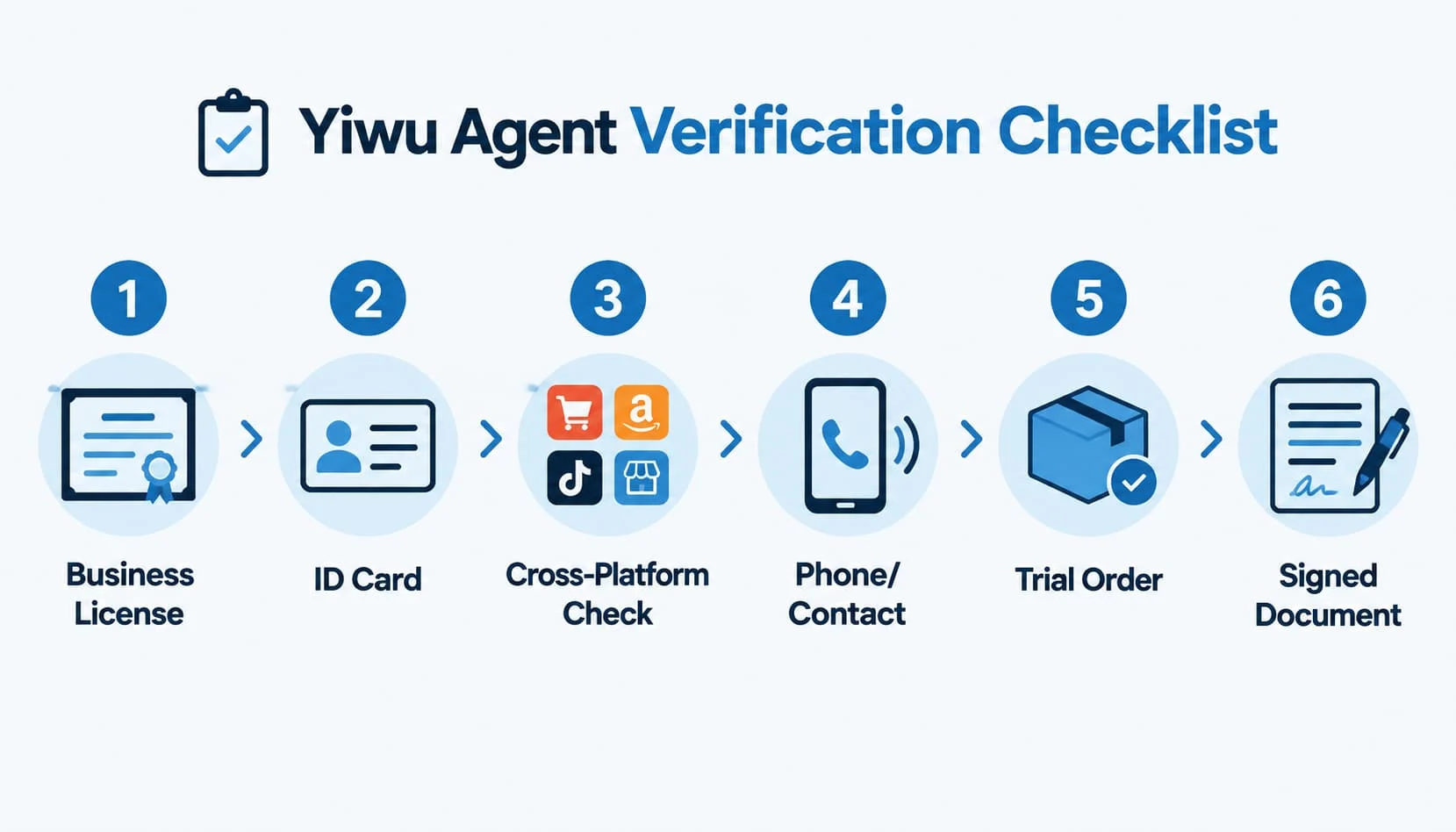
Look up the business license. China’s National Enterprise Credit Information Publicity System (国家企业信用信息公示系统) allows a public search of any registered company’s name, registration number, business scope, and registration date. Ask the agent for their registered Chinese company name and cross-check it there. A company that doesn’t appear, or whose registered scope has nothing to do with trading or sourcing, is a serious warning sign.
Request staff identification. A legitimate agent’s staff will provide a work ID, a company email address matching their website’s domain, and often a WeChat public account tied to the registered business rather than a personal account with no business affiliation.
Cross-check company details across every platform they use. Compare the company name, address, and registration number on their website, their WeChat profile, and any Alibaba or B2B platform listing. Consistency across all three is a basic, low-effort check that catches a meaningful share of fake operations.
Ask for and contact real client references. Don’t just accept a list of names; message at least one reference directly and ask about their actual experience, including how disputes were handled.
Start with a small trial order. Before committing to a large purchase, place a modest trial order and pay through a traceable business channel. How an agent handles a small order, including communication, timeline, and QC reporting, tells you most of what you need to know about how they’ll handle a large one. The full step-by-step vetting process, including what documents to request at each stage, is covered in step-by-step vetting process.
Insist on written fee terms before ordering. Get the commission rate, what it covers, and the payment schedule in writing before goods are sourced. A refusal to put terms in writing, after everything discussed above, is reason enough to walk away.
Smaller buyers with limited time or resources to run every check above face a distinct set of tradeoffs, covered in what small businesses should look for in an agent.
Frequently Asked Questions
Is Yiwu Market itself legit?
Yes. Yiwu International Trade City is a registered, government-linked wholesale market that has operated for decades and is the subject of extensive Chinese state media coverage. The fraud risk in Yiwu sourcing sits with unverified individual agents claiming to represent buyers there, not with the market’s legitimacy.
What’s the single biggest red flag when choosing a Yiwu agent?
A request to pay a personal account, personal WeChat, or Western Union instead of a registered business account. Combined with reluctance to do a video call or provide a checkable business license, this pattern precedes a large share of reported agent scams.
Can I verify a Yiwu agent’s business license myself?
Yes. China’s National Enterprise Credit Information Publicity System is a public database where you can search a company’s registered name, registration number, and business scope. Ask the agent for their exact registered Chinese company name and check it there before sending any payment.
How much should I expect to pay a legitimate Yiwu agent?
Transparent commission-based agents commonly charge in the range of 3% to 10% of order value, depending on order size and complexity. An agent advertising 0% commission or an unusually low flat fee deserves closer scrutiny for hidden supplier kickbacks. Full detail is in fee and commission breakdown.
The Bottom Line
The question worth asking isn’t whether Yiwu Market is safe. It is. The question that actually protects your money is whether the specific agent in front of you can survive a business license lookup, a video call, and a small trial order. Most fraudulent operators fail at least one of those tests quickly, because building a real business identity takes far more effort than building a convincing WeChat profile.
Run the checks in this article before you send a deposit, not after a shipment goes missing. If you’re still building your shortlist of agents to evaluate, the step-by-step vetting process in how to find a good Yiwu agent is the next logical read, and Union Trust’s own commission structure, published openly in the 3% to 6% range, is one example of what a transparent fee disclosure looks like in practice.