

Yiwu Market exists because small orders are its normal business, not an exception a buyer has to negotiate around. Most stallholders in Yiwu International Trade City are traders who buy in bulk from factories and resell in smaller, mixed lots, not manufacturers who need a large production run to justify starting a machine. That structural difference is why small buyers, side-hustle sellers, and first-time importers can source at Yiwu in quantities that a typical factory-direct supplier would reject outright.
This guide covers why Yiwu is naturally more accommodating to small and mixed orders than factory-direct sourcing, how a Yiwu agent lowers the effective minimum order even further, and what a sensible first small order looks like in practice. For the broader picture of what a Yiwu agent does, see the complete guide to Yiwu agents.
Key Takeaways
- Yiwu Market is built around traders, not manufacturers, so its normal unit of business is small and mixed orders rather than large production runs.
- A Yiwu agent lowers the effective minimum order further by consolidating goods from multiple suppliers into one shipment, negotiating sample-scale test orders, and steering buyers toward ready-to-ship stock instead of made-to-order production.
- A safe first order starts with one or two SKUs, a paid sample before any commitment, and a clear understanding of consolidation and warehousing fees before goods start arriving.
- Buyers should confirm any agent’s own minimum order value upfront since agents differ in how they structure this, regardless of how flexible the underlying market is.
Why Yiwu Market Is Friendlier to Small Orders Than Factory-Direct Sourcing
Factory-direct sourcing is built around production economics. A factory sets a minimum order quantity because running a production line, sourcing raw materials, and scheduling labor only make financial sense past a certain volume. Ask a factory for fifty units of a custom item and the answer is often no, or a per-unit price so high it defeats the purpose of buying direct.
Yiwu Market works differently because most of what happens on its booths is trading, not manufacturing. A large share of the vendors inside Yiwu International Trade City buy finished goods in bulk from factories in the surrounding region, then resell them off the shelf in whatever quantity a buyer wants, sometimes a single carton, sometimes a pallet. The booth owner has already absorbed the factory’s minimum order by buying in bulk once; the buyer standing at the booth doesn’t have to meet that minimum again. This trader-first structure is part of what makes Yiwu the largest small-commodity wholesale market in the world, built on volume across many small transactions rather than a small number of large ones.
That doesn’t mean every booth in Yiwu has no minimum at all. Some vendors, particularly those selling customized or private-label goods, still set a quantity floor because customization brings its own setup cost, similar to a small factory run. But the default posture across the market leans toward accommodating small, walk-in-sized orders, which is the opposite of what a buyer typically encounters when approaching a factory cold.

How a Yiwu Agent Lowers the Effective MOQ Further
Even with a trader-friendly market, a small buyer sourcing from several booths independently runs into a different problem: shipping cost per item becomes unworkable once each vendor’s small order has to travel separately. A Yiwu agent addresses this from three directions.
Consolidating Multiple Suppliers Into One Shipment
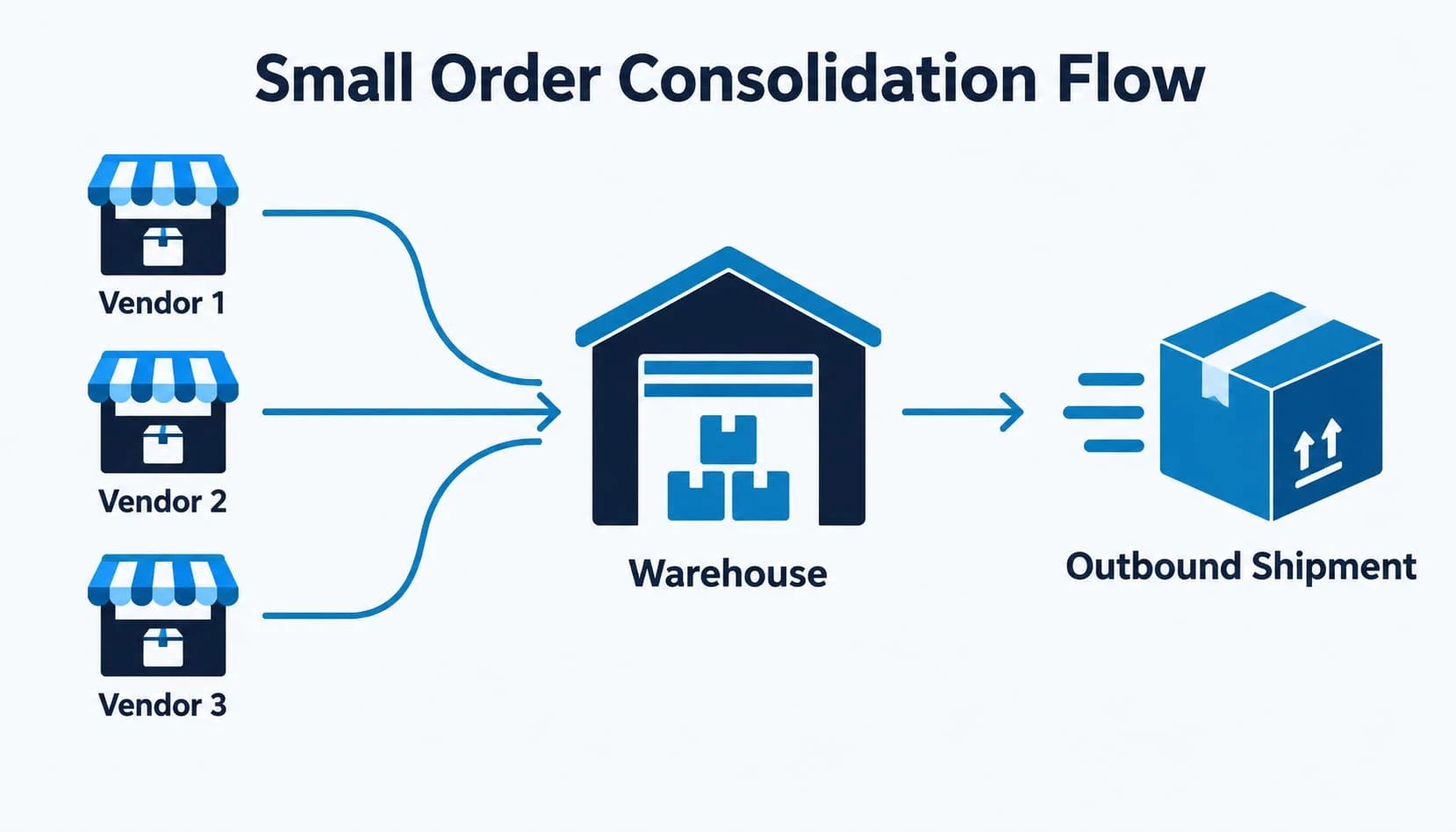
A buyer wanting a small quantity from ten different booths across five product categories faces ten separate shipping problems if working alone. An agent collects goods from all ten vendors into a single local warehouse, repacks everything into export cartons, and ships it as one consolidated shipment. This is the single biggest lever an agent has over effective MOQ: it turns freight cost from a per-vendor expense into a shared one, which is often what makes a small mixed order financially viable at all. The pillar guide covers this consolidation function in more detail as one of the four core services a Yiwu agent provides.
Negotiating Sample-Scale Test Orders
An experienced agent knows which vendors will accept a genuine test order, sometimes just enough units to evaluate quality and market fit, and which won’t budge below a set threshold. Because the agent has an ongoing relationship with many booths, a vendor is often more willing to fill a small test order for a repeat agent contact than for a first-time buyer with no track record. This negotiation leverage is one of the practical reasons a small buyer benefits from an agent even when the market itself is already flexible on quantity.
Favoring Ready-to-Ship Stock Over Made-to-Order Production
An agent familiar with a product category typically knows which suppliers hold ready inventory versus which require a production run to fulfill an order. Steering a small buyer toward vendors with stock on hand, rather than toward a factory that needs a minimum batch to start production, avoids the MOQ problem altogether for that item. This is a sourcing decision, not a negotiation tactic, and it’s one a buyer without local market knowledge has no reliable way to make alone.
Amazon FBA sourcing and shipping requirements
What a Small Test Order Should Look Like
Buyers new to sourcing from Yiwu, whether or not they’re using an agent, tend to make the same mistake: ordering too many SKUs at once for a first attempt, which multiplies the number of things that can go wrong on the first try. A few practical adjustments make a first order much lower risk.
Start With One or Two SKUs
Limiting a first order to one or two products, rather than the full catalog a buyer eventually wants to carry, keeps the order manageable and makes it easier to isolate problems if something goes wrong with quality, packaging, or timing. Once the process works smoothly for a small SKU count, expanding to additional products with the same supplier or agent carries much less risk than starting broad.
Request Samples Before Committing to the Order
A sample, paid or otherwise, confirms the actual product matches specifications before a buyer commits money to a full small order. This step matters just as much at small order volumes as it does at container scale, since a batch of defective goods is still a loss even when the total order value is modest. Buyers working through an agent should expect the agent to arrange and forward samples as a standard part of the process, not as an extra favor.
Understand Consolidation and Warehousing Fees Upfront
Consolidation is what makes small mixed orders economical, but it isn’t free. Agents typically charge for warehousing goods while they wait for the rest of a consolidated shipment to arrive, and for the labor of repacking multiple vendors’ goods into export cartons. A buyer should ask for these fees in writing before goods start arriving at the agent’s warehouse, since an unclear fee structure at this stage is a common source of disputes later. Buyers shipping to a European destination should also confirm how consolidation timing interacts with freight routing and customs, covered in Yiwu Sourcing Agent for European Importers.
What to Ask an Agent Before Placing a Small Order
Not every agent structures its own services the same way, and it’s worth confirming a few things before committing, regardless of how flexible Yiwu Market itself is on quantity.
- Does the agent have its own minimum order value, separate from any per-product MOQ at the vendor level? Some full-service agents set a floor on total order value to keep the arrangement worthwhile on their end, and a buyer should know this number before assuming a small test order is possible at all. Union Trust, for example, sets a $10,000 minimum order amount across its full-service offering, a floor tied to the cost of running dedicated QC, a named account contact, and consolidated freight on every order regardless of size, rather than an arbitrary cutoff. An agent with a lower or no stated minimum is worth asking what’s actually included at that scale, since full-service support has a real cost somewhere.
- How does the agent charge for consolidation and warehousing, and does that cost scale with the number of vendors involved?
- Will the agent arrange samples before the full order ships, and what does that cost?
- Does the agent have experience steering buyers toward ready-stock vendors when made-to-order production would kill a small order’s economics?
Getting clear answers to these questions before paying anything is consistent with the broader vetting process covered in How to Find a Good Yiwu Agent.
Frequently Asked Questions
Does Yiwu Market have a minimum order quantity?
There’s no single MOQ across the market since it varies by vendor and product. Because most Yiwu vendors are traders rather than manufacturers, many will fill small, mixed orders that a factory would refuse, though some vendors selling customized goods do set their own minimums.
Can a small business realistically source from Yiwu without a large budget?
Yes, particularly with an agent handling consolidation, since that’s what keeps per-unit shipping cost reasonable at low volume. Sourcing directly and shipping small parcels separately from many vendors tends to be far less economical than consolidating through an agent.
Is a test order with an agent worth the extra step?
For a first-time relationship with a new agent or a new product category, yes. A small paid test order confirms quality, communication, and fee transparency before a buyer commits to a larger, repeat order.
The Bottom Line
Yiwu Market’s structure, built on traders reselling small lots rather than factories requiring large runs, already favors small buyers before an agent gets involved. An agent adds value on top of that by consolidating multiple small vendor orders into one shipment, negotiating sample-scale test orders, and steering buyers toward ready-to-ship stock instead of made-to-order production. The safest way to start is small: one or two SKUs, a sample before committing, and a clear, written understanding of consolidation fees.
For buyers ready to take the next step, How to Find a Good Yiwu Agent covers how to vet an agent before placing that first order, and the pillar guide to Yiwu agents covers the full range of services an agent provides beyond MOQ flexibility. This guide draws on sourcing practices observed by Union Trust, a China-based sourcing agency that works with suppliers across Yiwu Market.